Showing posts with label Sun. Show all posts

Wednesday, March 9, 2016

Solar Eclipse


Here is my coverage of the March 9 Partial Solar Eclipse as seen from Project 6, Quezon City, Philippines. I setup my Sky-Watcher Explorer 150PL with my Baader solar filter for imaging and my Celestron Travelscope 70 with black polymer filter for visual observation. The initial forecast in the morning suggested partly cloudy skies but was fortunate to get good conditions except for the end of the eclipse.

The umbral shadow will pass through the waters of Indonesia giving us only a partial view. Originally the plan was for me and my friends from the International School for Young Astronomers to meet back at Indonesia for the eclipse but we weren't able to do so. Instead I took a leave today from work to cover the eclipse. As the eclipse progressed I tried to share the observations to the general public via Facebook.


The rest of the astronomical community are dispersed in different areas to cover the eclipse. In the coming days I hope I can feature the different solar eclipse activities here.

Tuesday, May 5, 2015

SolarActivity Picture of the Day


As I opened my Facebook this morning I was surprised at the first item in my news feed. My eyepiece projection shot for May 5, 2015 was selected as the SOLARACTIVITY PICTURE OF THE DAY. I'm not a pro at astrophotography like most of the members usually featured so I was quite pleased to find my image as the POD.


My photo was taken via an improvised eyepiece projection setup attached to my Sky-Watcher Explorer 150PL on a wooden dobsonian mount (or "alpha" as we call it). The seeing was great that morning so I was able to get good detail. I also recently have been experimenting on a new style of false color processing which gets rid of the burnt out look in the limb. [see original image here]

If you want to check out great solar images (white light, H-alpha, CaK, etc.) from different observers around the world check out the SOLARACTIVITY group.

Thursday, February 26, 2015

Solar and Lunar Image

Here is the solar image from today, and the lunar image from last night.

The Sun currently has a low sunspot activity, so observations would be ideal in other wavelengths at the moment rather than in white light. There is a grouping at the center (below solar equator) that currently has no NOAA designation.


Friday, January 9, 2015

Solar Image: 10 January 2015


Today is a bright & sunny Saturday morning. There are several sunspot groups in the Sun today. I've been receiving good feedback for my 3D rendering of transit ARs from the solar imaging community that I've decided to add them to my usual whole disk white-light images (which are now posted at the sidebar of this blog). The 3D render brings out much detail in the umbral and penumbral structure of the sunspot groups.

AR 2257 is growing in size and may pose a threat for M-class flares. It currently has a McIntosh class Dki and released 3 C-class flares yesterday (C 9.6, C 1.8, C 1.9).

Another sunspot group that seems to be growing in size is AR 2259 [Eko] with two C-class flares yesterday.

You can check out my paper on Sunspot data extraction through 3D rendering at:
You can also choose to join our solar community on Facebook at Solar Activity.

Monday, June 23, 2014

International Sun-Day Report

Participants pose beside the telescopes

The Solar Observation Program (SOP) in cooperation with the RTU Astronomical Society had a setup in the quadrangle of Rizal Technological University. We setup two telescopes for the public observation: a Sky-Watcher SkyLiner 200P with a black polymer filter and a Lunt LS60THa Solar Telescope. For most of the participants it was their first time to look through an H-alpha telescope to view the Sun. Several freshmen students were present as well who have never experienced solar observations. Solar glasses from the Charlie Bates Solar Astronomy Project were also distributed by SOP member Margareth Custodio. The sky was generally clear although a few clouds rolled in every once in a while.

Students viewing the Sun through the CBSAP solar glasses
Students taking turns peeking at the Sun

Teaching how an H-alpha telescope works

 After the public observation we proceeded to the astro-auditorium to watch Star, an episode from BBC's Planets. The film Star discussed concepts about our own star and how our understanding of it has developed through the years. It was followed by a Q&A where students opened up their questions regarding the Sun.

Astronomy students pose for a group shot after the film showing.

Afterwards the group proceeded with lunch and some members came along to join forces with another participating partner in Rajah Sulayman park - the Astronomical League of the Philippines.

The setup of ALP at Rajah Sulayman park


-Norman Marigza
Head, Solar Observation Program

Saturday, May 10, 2014

Solar Morphology

Here is another animated gif image of the Sun for the period of April 20 to May 9. 

I've been wanting to do this for quite some time but always get interrupted by days with no data (either due to bad weather or absence from my equipment during trips). This gif sequence allows us to view the daily changes in the structure of each active region as they go about their solar transit. This animation was done on a daily basis and images were mostly taken in the morning before I leave for work. My next goal is to do this with shorter time intervals between shots (perhaps one in the morning and in the afternoon) to better monitor the slight changes in the sunspot group structure. I have already planned the project with two astronomy students from RTU - Mico Enriquez and Margareth Custodio.

Sunday, April 13, 2014

Morphological View of the Sun

Here is a little animation showing the daily changes in the solar surface. I plan to track the transit of AR 2032 across the solar surface. Hopefully I won't have any cloudy days to cause gaps in the data. The following is taken from April 9 - 13, 2014.


Monday, April 7, 2014

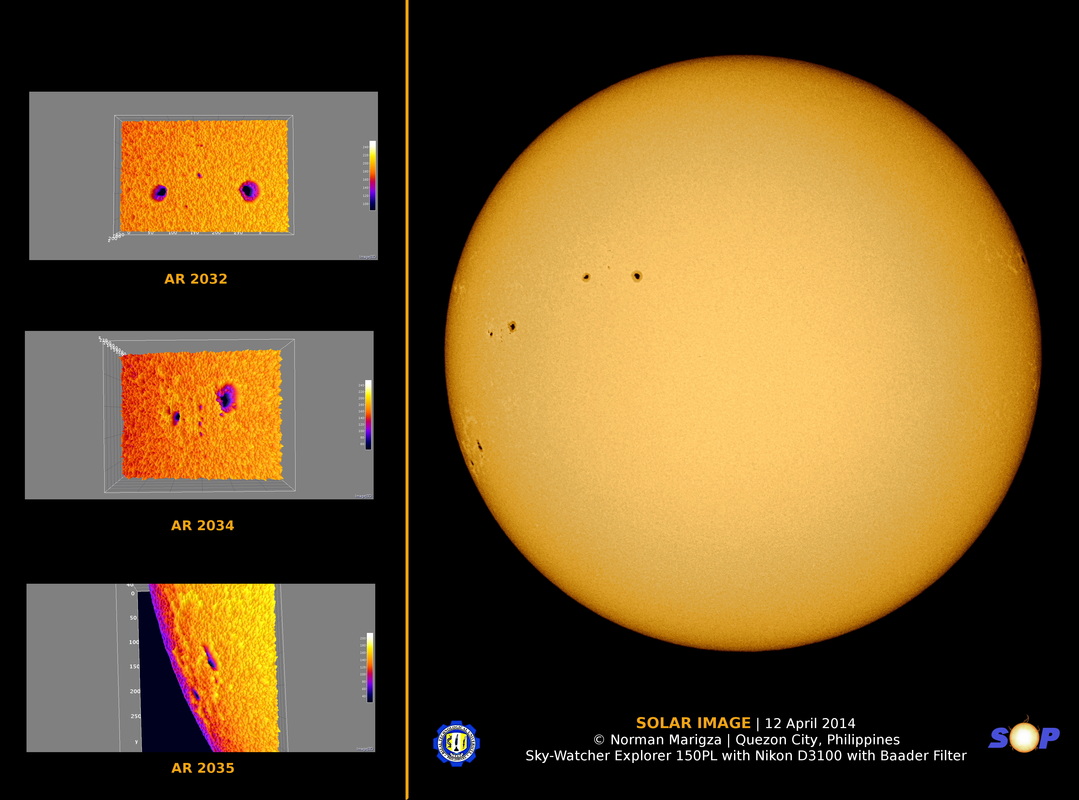
3D Sunspot Rendering using ImageJ

Resolution is one problem in scientific image data acquisition. In observation of sunspot groups, we need to have enough resolvable detail to make out the proper features for sunspot counting and McIntosh classification. A lack of resolution may lead to lower estimates to the level of solar activity. As a result, some image processing measures are taken to improve resolution, however this tampers with the data.

A useful technique is to render an isophote of the image in order to make out details. Isophotes use pixel intensity to map out areas with different concentrations. This is usually used in mapping out topological terrain.

The software ImageJ allows users to construct 3D isophote rendering of sunspot groups. This helps make out points which are hard to see visually. Intensities can also be adjusted to make out fainter points.


Thursday, January 9, 2014

Solar Observation: 9 January 2014


Here are some images taken for the Solar Observation Program (SOP) in RTU. With me were Raven Pelobello and Babie Rose Quiniquis, two of the freshmen members of the SOP.

Of particular highlight right now is the huge sunspot group AR 1944 (above image) which over the past few days has released several flares including an X-class flare. The size and structure of the sunspot group puts it at an Fkc classification which corresponds to a high solar flare probability. NOAA forecasters estimate an 80% chance of M-class flares and a 50% chance of X-ray flares over a period of 24 hours.

Wednesday, August 7, 2013

The Magnetic Flip

Recent news have been mentioning the upcoming flip of the Sun's magnetic poles.
What is a magnetic flip and how exactly does it happen?


Our sun transfers energy from the core to the radiative zone, and then to the convective zone, and out to the photosphere (the visible disc of the sun). The vertical motion of the plasma in the convective layer causes the magnetic field lines to twist into flux tubes. When the flux tube increases its energy it then rises as an active region. The magnetic field lines arch from these areas from one polarity (+) to the other (-). The magnetic polarities of each active region is similar but reversed in each hemisphere.

Now, the Sun has a solar cycle described as a period of very few magnetic activity followed by increasing activity over a time of 11 years. The year 2013 is the solar maxima which signifies the end of the current solar cycle. After the 11-year cycle, the magnetic polarities of the active regions suddenly reverse and will remain as such for another 11-year cycle. So a period of 22-years make up one magnetic cycle of the Sun.

The Sun's northern hemisphere has already reversed its polarity as you can notice in a period of almost 0 activity for the month of July (see absence of AR regions in the Northern part for the month of July in these solar images). The southern hemisphere is following suit.


So what does a magnetic flip do?
Well, the Sun has a region of influence called the heliosphere which reaches out to the ends of the solar system. We monitor this sphere as what we call space weather. Charged particles (cosmic rays, plasma, etc.) in space travel with respect to the magnetic field lines of the Sun and of the planets. When the magnetic orientation of the Sun flips then so does the orientation of these charged particles. The sudden switch causes a storm in the space weather.


Solar Observation Program
Department of Earth and Space Sciences
Rizal Technological University

Wednesday, June 5, 2013

5 June 2013 - Solar Observation

This morning I setup the 8" Sky-Watcher SkyLiner with our intern from the University of Michigan and some BS Astro-Tech students for a solar observing session. Two sunspot groups were very prominent AR 1762 and AR 1764. Other sunspot groups were noticed later through imaging.


From our observations, the computed sunspot number R is 82.83 with 3 sunspot groups in the Northern Hemisphere (a 3rd with no AR designation as of 11 AM), and 3 sunspot groups in the Southern Hemisphere.


Saturday, April 20, 2013

21 April 2013 - Solar Observation

It has been currently very hot here in Manila, Philippines with temperatures exceeding that of the previous years. Makes me want to wonder more about its relation to the current solar maxima. Anyways, I decided to take my telescope out to observe the Sun.

Here you can see two of the rapidly emerging sunspot groups - active regions 1726 and 1727 - in the Sun's Northern Hemisphere.


Wednesday, December 19, 2012

December 19 Solar Image

Low solar activity in the past few days. The triangle formation of two active regions AR 1633 and AR 1634 plus a new sunspot AR 1635. The low activity means minimal flares and almost a 0% chance for a coronal mass ejection. This contradicts any December 21 doomsday scenario associated with the sun.


Image in white light (color edited) through a glass filter attached to a Sky-watcher Explorer 200 with Nikon D3100 at prime focus.

Monday, October 10, 2011

Storms from the Sun

The Sun - the source of light, the source of life.

I've recently began to take interest in solar astronomy since it is the easiest object to observe during these period of cloudy nights and rain. The sun is the closest star. It is a source of energy and it defines the seasons of the Earth. This 4.5 billion year old star is not just a static ball of hydrogen gas, but is a very lively and sometimes destructive object.

The sun goes under an 11 year solar cycle discovered in 1843 by the German astronomer Heinrich Schwabe. He noticed the the number of visible sunspots (cooler regions in the sun's surface) varied; lesser and almost absent during the solar minimum, and more visible during solar maximum. Whenever a solar maximum approaches the sun becomes more active and CMEs (Coronal Mass Ejections) become more frequent.

My image of the huge Sunspot AR 1302. Image taken via MicroObservatory.
Recently, a large sunspot AR 1302 was observed. It caused several CMEs and X-class solar flares which caused geomagnetic storms in Earth. A Coronal Mass Ejection is the explosion of an enormous ball of electrified gas from the corona (outer solar atmosphere) which sends large amounts of plasma flying out into space at tremendously high speeds (up to 5 million mph). They are caused by the snapping of magnetic loops that were continuously stretched and twisted.

The electric currents that a CME generates produce geomagnetic storms on Earth, visible as auroras. Normally, when energetic particles from the Sun interact with particles from the atmosphere they get excited and form these beautiful lights at the pole regions. However, when huge amounts of energy, as that released in a CME, reacts with the Earth's magnetic field, they get to interact with more particles in the atmosphere and thus these auroras move to lower latitudes.

CMEs can alter the magnetic field in space and on the Earth. It can heat up and expand the atmosphere. It can also set off electrical surges in power lines and oil pipelines and can cause major blackouts, communications problems, and satellite damage.

Geomagnetic Storm. Image by Gordon McLellan. Sep 26, 2011. Pentax K-x with Tamron 10-24 @ 10mm, f5.6 iso 1600, exposure around 40 seconds.


Here are some useful links related to this post:
Daily Sun Images and Movies. SOHO (Solar and Heliospheric Observatory)
Solar Images from the Philippines. TV-101 blog page.