Showing posts with label AstroArt. Show all posts

Friday, September 4, 2015

Dots in Space

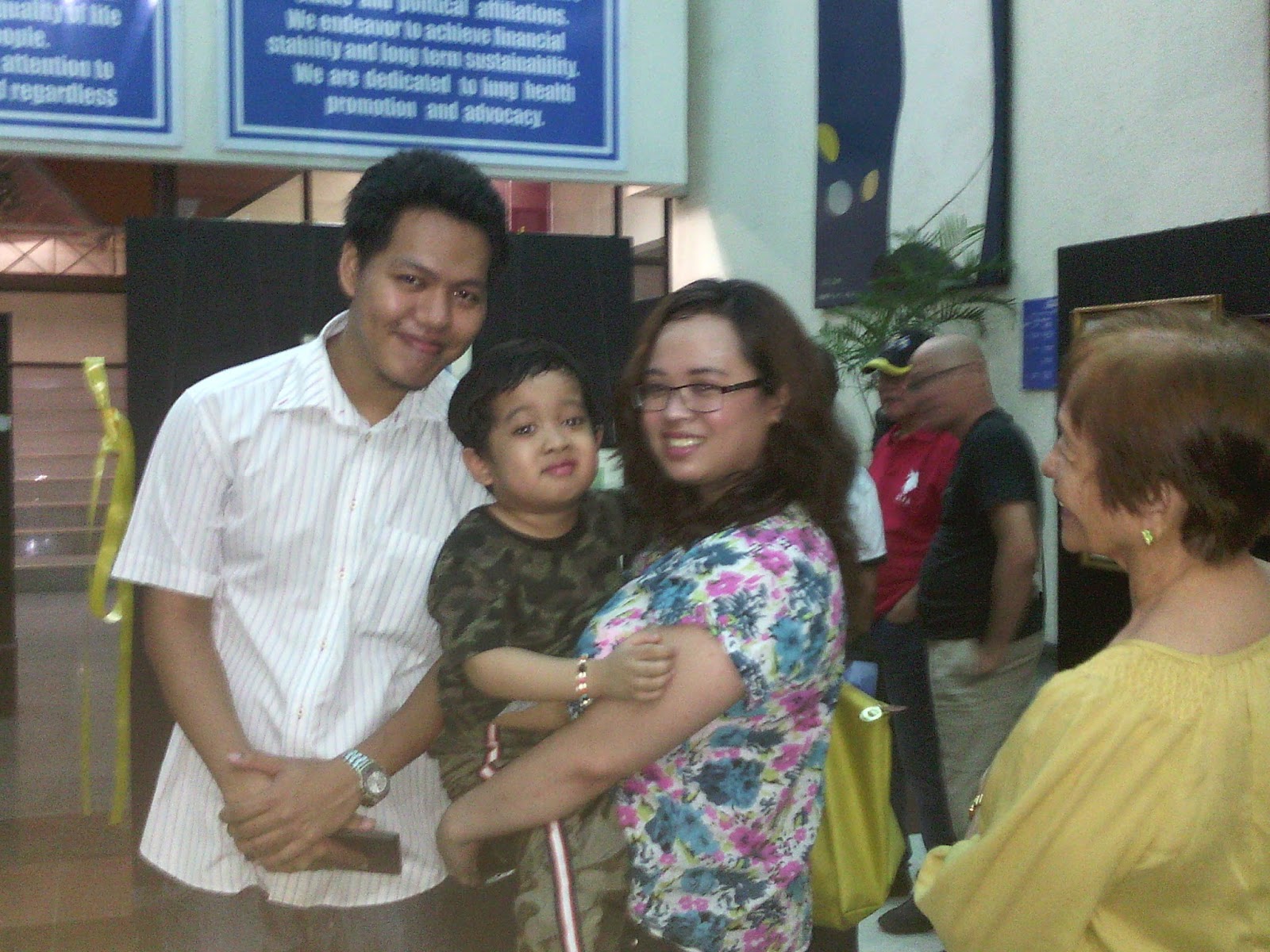
Meet Aedan Pio, an intelligent 4-year old boy with a passion for space. He dreams of being an astronaut, and is a promising astro artist who does watercolor paintings of the planets. Sadly, Pio has a condition called chordoma (a rare kind of brain cancer).

To assist Pio, the Lung Center of the Philippines in coordination with Oxygen Art + Design Gallery will be hosting a fund raising art exhibit entitled Dots in Space. The exhibit will run from Sept 4 - Oct 6, 2015 at the lobby of the Lung Center (Quezon Avenue, Quezon City). Pio has several watercolor paintings of the solar system being sold as well as some paintings by his grandmother. I also contributed four paintings in the exhibit. Other astro artists and imagers are encouraged to add to the ongoing exhibit to help Pio.

As I looked at Pio's paintings I was amazed how he has certain details about the planets such as their colors and features. One particular painting I saw has all the terrestrial planets on one side and the gas giants on the other with Pluto located away from the line-up in accordance with its current dwarf planet status. During the short chat I had with Pio he asked me why Jupiter is so big. I was also surprised to Pio's response when his mom told him to ask me what is Jupiter made off. He responded by saying that Jupiter is made of mostly Hydrogen and Helium.

One of Pio's paintings.

For those interested to contribute you may contact me here, or reach the exhibit curator Dara Solevilla at 09153023274.

Friday, May 22, 2015

Solaractivity Picture of the Day (May 20)

My sunspot painting was selected as the Solar Activity Picture of the Day for the 20th of May.


I've been recently cooped up indoors (against my will) while renovations are being done at home. With all the clutter and construction taking place I couldn't manage to drag 'alpha' out for solar imaging/data gathering. So for two afternoons I worked on this painting of a sunspot group.

Monday, April 21, 2014

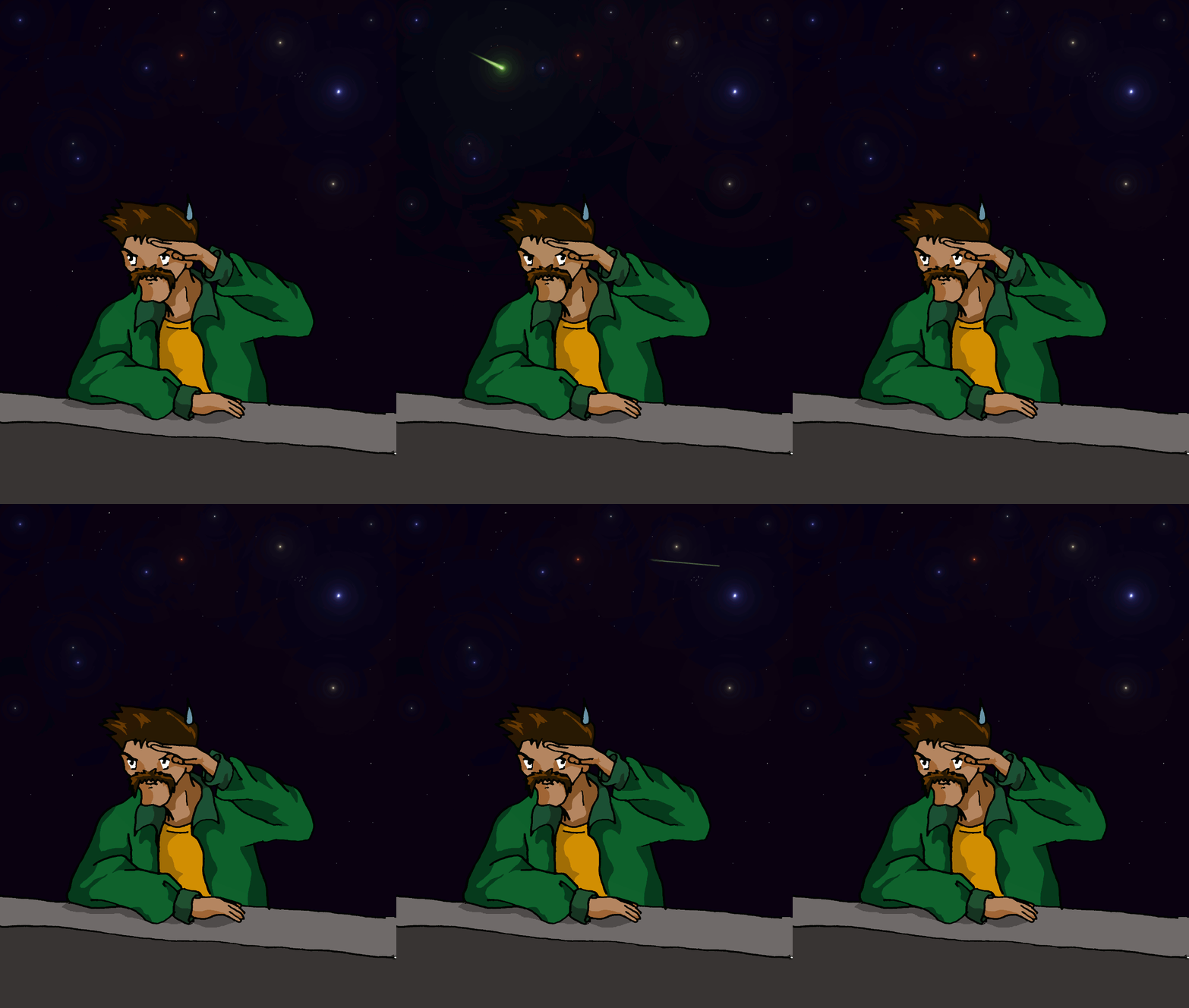
A Comic Guide to Observing Meteors

Here's a little something to serve as a practical guide to observing meteors. I hope you enjoy it.


1. During a meteor shower be sure to observe in a dark site. The darker the site the better the visibility for meteors. Observing near city lights or during a bright phase of the moon will limit your visibility. However, make sure that the dark site is secure.


2. Know where to look. Meteor showers are named after their apparent source or radiant. Look for meteors away from the proximity of the radiant. Using star charts may be helpful.


3. Grab a mat or reclining chair so you can observe the meteors with ease. You may end up with a stiff neck if you don't.


4. Use insect repellents. You want to be counting meteors and not counting bites or swatting at elusive mosquitoes.


5. Check the weather forecast prior to a scheduled observation. The last thing you want is to waste your time waiting for clouds to clear up.


*PS. If you have other things you want me to add, feel free to comment :)

Friday, October 26, 2012

Astroart - Chibi Astronomers

Just for fun. I doodled some chibi version of me and my batchmates in the MS Astronomy degree program. Here we are carrying our respective telescopes. From the left, you have Lieza with a Meade ETX90, Pamela with an Astromaster70, Vanessa with an Astromaster130, and me with a Sky-Watcher Explorer 150PL. :)

Tuesday, May 29, 2012

Venus Transit - Astro Art

Transit of Venus
medium: acrylic on paper

A picture is said to paint a thousand words, so here is my astronomical artwork in promotion of the Venus Transit. Shown here is the passing/transit of Venus in between the Sun and Earth. Venus here is carried by the mythological figure Venus/Aphrodite - the Roman goddess of love, beauty and pleasure and procreation. On Earth is a refracting telescope representing observation which is done safely through projection method.

Monday, April 23, 2012

Astronomical Sketching

One of the activities we've been doing in astronomy is astronomical sketching. We take time to view different celestial targets through a telescope/binoculars, and sketch the field of view into the eyepiece. This activity helps sharpen an astronomer's visual observing skills, and also helps the observer to be more familiar with the object and how it really looks like through the eyepiece. The process is much more time consuming (some open clusters can take roughly 30 mins to sketch), however the results of a good sketch can be rewarding.


To the left is a lunar sketch of the Copernicus crater.
Lunar sketching helps you practice your ability to do shading and helps you study the structure of the moon's surface.


Here is a sketch of the Lagoon Nebula (Messier 8) in Sagittarius as observed from a 6" Newtonian with a 25mm WA eyepiece. The sketch has been inverted in MS Paint to resemble the actual appearance as seen in the eyepiece. The nebulosity is created by gentle smudges of pencil. One can make use of a paper stump to get better smudges.


Here is a sketch of the Scorpius Jewel Box (NGC 6281).
For open clusters such as this, one will strive for accuracy in their drawings. What I usually do is form triangles between stars, or lines of three stars, taking careful note of the spaces between them.

Thursday, November 10, 2011

Filipino Entries in the InOMN Art Contest

Please vote for the Filipino entries to the International Observe the Moon Night Art Contest.

Voting can be done at  surveymonkey.

The contest goes with the theme "What Does the Moon Mean to You?" where Each submission should convey a personal connection to our nearest celestial neighbor, describe the significance of the Moon to your respective culture, or highlight one or more of the ways in which the Moon has inspired you.

Here are the Entries from the Philippines
Painting:
5 Day Old Moon. By (Me) Reuel Norman A. Marigza, Jr.

Poetry:
Orb of Light. By (Me) Reuel Norman A. Marigza, Jr.

Landscape Photography:
Peeking the Moon through the telescope. By Angel Constantine Bajana
Thin young Moon and two Inner Planets, Venus and Mercury . By Ma. Criselda Roque (Raven Yu)
Old Lunar Crescent in the Southeastern Sky During Predawn. By Ma. Criselda Roque (Raven Yu)
A Marvelous Apparition of a Blood-Colored or Deep Red Moon. By Ma. Criselda Roque (Raven Yu)
October 22, 2011, a Nice Celestial Pairing of the Waning Cresent Moon and the Tiny Planet Mars. By Ma. Criselda Roque (Raven Yu)


Astrophotography:
Largest Full Moon of 2011. By Ma. Criselda Roque (Raven Yu)
Montage of Total Lunar Eclipse Photos. By Ma. Criselda Roque (Raven Yu)

Sunday, July 17, 2011

AstroArt

Aside from astronomy, I am, also engaged in visual arts. I'm currently getting fond of doing Astronomical Art (or space art as some may prefer). My previous post of paintings can be found here: http://blogstargazers.blogspot.com/2010/01/astroart-by-norman.html
http://theskyabove22.wordpress.com/2010/01/24/norman-marigzas-astronomy-art-attack/


Astronomical Art is a means in which visual artists can merge the science of astronomy with art. It isn't merely depicting a starry landscape with planets but also trying to combine actual data to give an accurate representation. Some artists choose to call "space art" paintings with a spaceship of some sort. Often, you would see artist impressions on the covers of astronomy magazines or books. That's because astronomical art has the advantage of going beyond the visual wavelengths.

Here are some of my latest works mostly done with acrylic:


finger paint montage of the solar system (acrylic)


a comic merging of the telescope known as Astroscan to the popular Plants vs Zombies

Blood moon

coronal loops in the photosphere

the Hayabusa spacecraft

IC 342

an aerial view of Olympus Mons


Pleiades cluster

Primeval worlds during planetary formation filled with debris and planetesimals

the Ring Nebula in Lyra

Sagittarius

Star-crossed lovers

a fictional image of an astronaut planting in Mars in hopes of terraforming the planet

instead of a Schmidt-Cassegrain on a fork-mount, I replaced it with a head to depict an individual's amazement for stargazing

a space art painting of an interstellar ship approaching a star

depiction of the 12 zodiac constellations used in the pseudo-science astrology

Friday, May 13, 2011

Comet Hyakutake at BenCab Museum

While I was studying in Dumaguete, my cousin tagged me in one of her photos in facebook. It was a picture of an astronomy related painting that she took from the BenCab Museum in Baguio City. When we came home to Baguio I finally got the chance to see the wonderful paintings in BenCab's museum. Being a visual artist as well I was really fascinated! Finally I got to see the painting - it was entitled Comet Hyakutake, an oil painting by Elmer Borlongan. Since I began doing astronomy paintings I enjoyed seeing other artistic creations of space.


Elmer Borlongan (below) is a fine arts graduate from the University of the Philippines and an artist awardee of the Cultural Center of the Philippines.


Monday, January 18, 2010

AstroArt by Norman

Two of my passions are Astronomy and Art. Here are some of my paintings where I merged both astronomy and art: