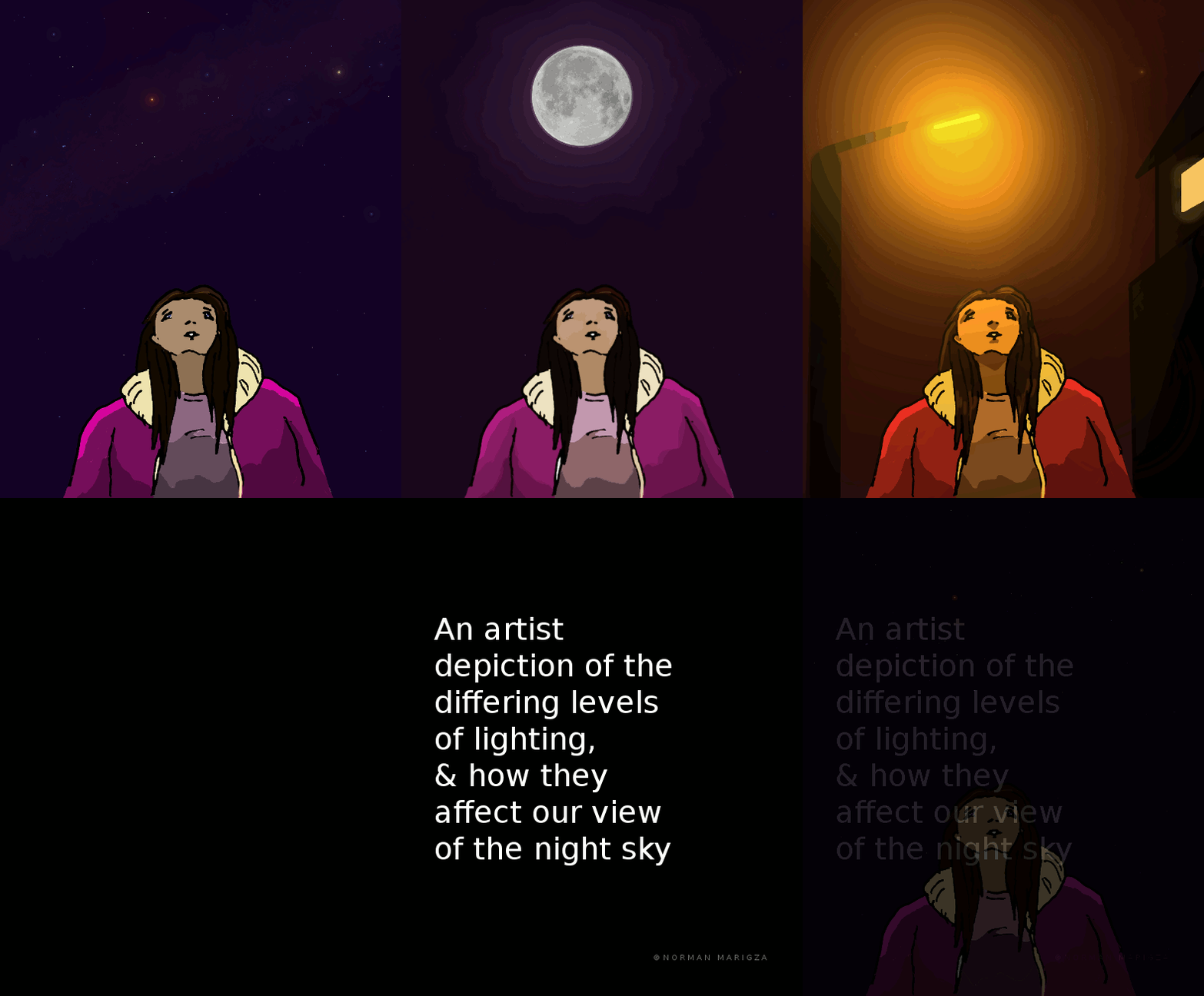
Showing posts with label meteor showers. Show all posts

Monday, April 21, 2014

A Comic Guide to Observing Meteors

Here's a little something to serve as a practical guide to observing meteors. I hope you enjoy it.



1. During a meteor shower be sure to observe in a dark site. The darker the site the better the visibility for meteors. Observing near city lights or during a bright phase of the moon will limit your visibility. However, make sure that the dark site is secure.


2. Know where to look. Meteor showers are named after their apparent source or radiant. Look for meteors away from the proximity of the radiant. Using star charts may be helpful.


3. Grab a mat or reclining chair so you can observe the meteors with ease. You may end up with a stiff neck if you don't.


4. Use insect repellents. You want to be counting meteors and not counting bites or swatting at elusive mosquitoes.


5. Check the weather forecast prior to a scheduled observation. The last thing you want is to waste your time waiting for clouds to clear up.


*PS. If you have other things you want me to add, feel free to comment :)

Friday, January 6, 2012

2012 – A Year for Meteor Showers


The year 2012 is a year for meteor showers, and I don’t mean in relation to the apocalyptic end-of-the-world scenario as some may believe. This year is a year for meteor showers because the new moon coincides with most of the major meteor showers. This means that you can see more of the meteor shower because the light from the moon does not interfere with the fainter meteors that streak by the Earth’s atmosphere. It is simply a case of brighter light dimming the fainter lights. The new moon is always the best time for observing if you wish to see fainter targets – provided of course that you are away from light pollution (bright city/house lights) and that the weather cooperates.

There are 7 major meteor showers and four of them have their peaks during the new moon. They are the Lyrids (April 22), Orionids (Oct 20), Leonids (Nov 13), and the Geminids (Dec 13). This year will be the best time for observing meteors since the next two years will only have one meteor shower during the new moon (Perseids – 12 Aug 2013; & Quadrantids - 3 Jan 2014).

The Lyrids meteor shower has a zenithal hourly rate (ZHR) during the peak of 20 meteors per hour. Its radiant (apparent source or point of origin in the sky) lies a few degrees from Vega in the constellation Lyra. The source of this meteor stream is the comet Thatcher.

The Orionids meteor shower has a ZHR during the peak of 25 per hour. The radiant appears to be along the right arm of Orion the hunter. The source of the meteors is the comet 1P/Halley.

The Leonids meteor shower has a ZHR during the peak of 20 per hour but usually varies and becomes a meteor storm that can generate up to 1,000 meteors per hour. In November 1966 the ZHR was approximately 100,000 per hour. The varying rate suggests that the meteor orbit is fairly young. Its radiant lies inside the asterism of the sickle in the constellation of Leo. The stream originates from the comet 55P/Tempel-Tuttle. The meteors move across the atmosphere with speed of 44 miles per second and as a result would generate more fireballs (very bright meteors) from large amounts of friction with the atmosphere.

The Geminids meteor shower, a personal favorite, has a ZHR during the peak of 120 per hour (approx 2/min). Although the slowest of the meteor showers, the Geminids still produce fireballs as a result of their denser and heavier meteors. The radiant of the meteor is close to Castor of the constellation Gemini. The stream originates from the asteroid 3200 Phaethon.

Monday, October 3, 2011

Stargazing October 2011

Here are some highlights for October 2011. It's been a while since I posted a calendar of astronomical events in this blog so here I go again.

World Space Week
October 4-10. World Space Week is an international celebration of science and technology, and their contribution to the betterment of the human condition. The United Nations General Assembly (1999) selected the dates, Oct 4-10, to commemorate the first launch of the first man-made satellite (Sputnik 1; 4 Oct 1957), and the signing of the Treaty of Principles Governing the Activities of States in the Exploration and Peaceful Uses of Outer Space (10 Oct 1967). This year's theme is "50 years of Human Space Flight."

Draconids Meteor Shower
October 8. This meteor shower is projected to have a sudden outburst this 2011. The highest rate for the Draconids was 1000/hr recorded on 1933. Since the meteors radiate from Draco, it is best to view this shower at latitudes where Draco is close to your Zenith (point above your head). For the Philippines, Draco doesn't approach our zenith, but will still be visible. However, the moon will be in its gibbous face so light from the moon will conceal the fainter meteor streaks.


La Luna del Cacciatore (Hunter's Moon)
October 12. Anyone who's an avid fan of the first AVP movie will surely recognize the phrase "Hunter's moon." The Hunter's moon is also known as the Blood Moon or Sanguine Moon. It is the first full moon after the Harvest Moon. The name Hunter's moon came from the benefit of moonlight to hunter's in shooting migratory birds. Also, Native American Indians also are said to stalk and hunt prey during this time to prepare for the upcoming winter.

Comet Elenin's closest Approach
October 16. The comet's orbit will bring it within close to 22 million miles of Earth. The comet was discovered by Russian amateur astronomer Leonid Elenin in Dec. last year.

Solar Week
October 17-21. More on Solar Week.
 
Mercury-Venus Conjunction
October 20. Conjunction, in astronomy, happens when two objects are apparently close to each other in the night sky. On October 20 watch the sunset and look for two bright points of light close together.

Orionid Meteor Shower
October 22. Coming from the same meteoroid stream as the Eta Aquarids, the Orionids belong to the debris left by Halley's Comet. It's zenithal hourly rate (rate when the radiant/source is close to the zenith) is 25 per hour. The source will be easy to locate, just look for the iconic Orion's belt. * * *

Jupiter at Opposition
October 29. A planet in opposition is in it's closest approach to Earth. This is when the planet will be exactly opposite to the position of the Sun in the sky, and will be most suitable for observing.

Friday, May 7, 2010

Annual Meteor Showers

Here's a little something for the meteor watchers:

There are meteor showers that regularly occur in every year. How we know when and where this meteor showers occur is simple. There are streams of debris from comets that pass along the Earth's orbit. This debris are called meteoroids. Now, the Earth ends up almost at the exact position after one revolution. And because the Earth ends up in exactly the same place it reaches the meteoroid stream in almost exactly the same time and the same place in its orbit. When this stream of debris come in contact with the Earth's atmosphere, a meteor shower is produced.

To help you locate meteor showers, they are usually named after their radiant (i.e., Leonids meteor shower can be found in Leo; Delta Aquarids radiate from the delta star of Aquarius).
 Here is a list of the prominent meteor showers (visible to the Philippines). There are other showers aside from this but they have very low ZHRs.

January:
Quadrantids Meteor Shower 
Quadrantids, as you may have noticed, does not resemble any of the 88 constellations. This is because the Quadrans Muralis, in which it is named from, is an obsolete constellation. This is located somewhere along Hercules, Bootes and Draco.
Peak: January 3/4
Active Period: January 1 - 6
ZHR (Zenithal Hourly Rate, the amount of meteors per hour during the peak): 90

April:
Lyrids Meteor Shower
Originating from the debris of comet Thatcher. This meteor shower originates from the constellation Lyra which rises up in the east at around 11:30.
Peak: April 22
Active Period: April 19 - 24
ZHR: 12


May:
Eta-Aquarids Meteor Shower
This meteor shower radiates from the Eta star of the constellation Aquarius. It's parent comet is the famous Halley's comet.
Peak: May 5/6
Active Period: May 1 - 8
ZHR: 45

June:
Lyrids Meteor Shower (June Lyrids)
Another meteor shower originating from Lyra.
Peak: June 15/16
Active Period: June 10 -21
ZHR: 9 - 10

July:
Delta Aquarids
Radiating from Aquarius' Delta star. It's parent comet is unknown. This shower produces bright yellow meteors.
Peak: July 28/29
Active Period: July 15 - Aug 15
ZHR: 19

Capricornids
This meteor shower produces bright yellowish fire balls. They strike the atmosphere slowly at an average of 15 miles per second.
Active Period: July 29 - 30
ZHR: 15


August:
Perseids Meteor Shower
Originating from the comet Swift-Tuttle
Peak: Aug 12/13
Active Period: Jul 25 - Aug 18
ZHR: 80


October:
Orionids Meteor Shower
Coming from the same meteoroid stream as Eta Aquarids, the Orionids belong to the debris of Halley's comet. Radiating from Orion, the hunter.
Peak: October 21
Active Period: Oct 16 - 26
ZHR: 25

November:
Taurids Meteor Shower (and Leonids)
A fascinating meteor shower that appears as two showers in one. It is a combination of Taurids and Leonids. Comet Encke is the source of this shower and Comet Temple-Tuttle.
Peak: Nov 5 and 17/18
Active Period: Nov 4 - 7 and Nov 15 - 19
ZHR: 8 and 10


December:
Geminids Meteor Shower
The most prominent and the most reliable of the annual meteor showers. This meteor shower comes from debris of the asteroid 3200 Phaeton. This shower creates a multi-colored display of meteors, most bright white, and then yellow, and then blue, red and green.
Peak: Dec 13/14
Active Period: Dec 17 - 15
ZHR: 80

Thursday, November 5, 2009

This Month's Meteor Shower

January's meteor shower will be the Quadrantid meteor shower.
Peak: January 3 4:33 PM
Activity: Jan 1 - 5
Rate: ZHR 100/hr (20-30 when observed 6 hours before and after peak)
Remarks: Lasts for a few hours, hardly observed. Although short, peak produces plenty streaks.

Friday, June 26, 2009

Meteor Shower

July's meteor shower will be the Delta Aquarids meteor shower.
Peak: July 28 10:09
Activity: --
Rate: --
Remarks: --
Constellation: Aquarius