We know that through atmospheric lensing the lunar surface changes its hue from the normal gray to anywhere between yellowish to red. But did you know that the Moon isn't actually just gray.

The Moon contains subtle hints of color that is not normally seen by our eyes. Photographic methods can bring out these subtle variations of color. These various hues are a result of the chemical distribution and abundance in the lunar surface. The mare regions or the 'seas' (the darker areas) have lower capacity to reflect light because of higher ferrous oxide (FeO) content. The bluish hues are a result of the abundance of titanium oxide (TiO2) which further limits the surface reflectivity. TiO2 has a high distribution in Mare Tranquillitatis (Sea of Tranquility); seen in the photo as the blue region. Orange and purplish hues are a result of the lower abundance of TiO2 and FeO. The pinkish hues are from iron-poor, aluminum-rich lunar highlands.
Here are some other images of the Moon in exaggerated colors to provide contrast from the common Lunar hue:
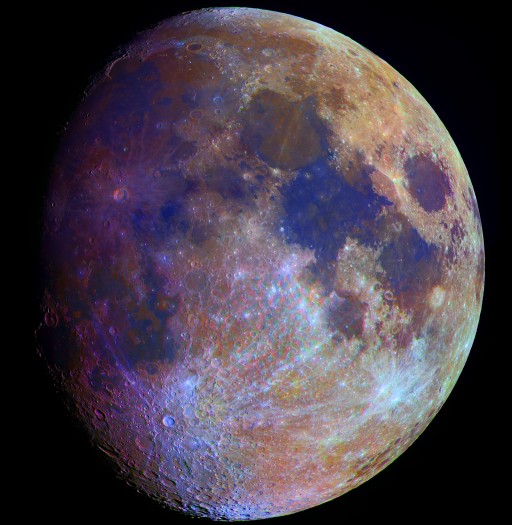
Here is an image entitled 'The Color of the Moon' from APOD (16 February 2006) by Johannes Schedler (Panther Observatory).
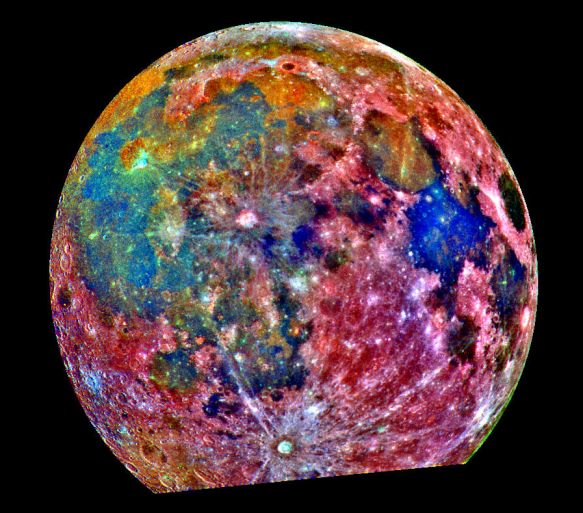
Not only do ground based observers try to see these colors but spacecraft as well. Here is another one by the Galileo spacecraft imaged in 1992.
- - - April 20, 2019 - - - For those coming to this blog post in relation to the pink Moon - - -
The Pink Moon is merely a name given by the Native Americans to the Full Moon of April due to it coinciding with the onset of the blooming of the pink phlox (a flower in North America). This name and other Moon names do not apply to the Philippines.
Here is my original post caption to this link being shared:
Alright, allow me to weigh on this from an astronomer's perspective.
Friend's in the local astronomy community have been tackling the pink tinted photos being shared on social media with good reason - they are not real and are reinforcing the wrong notion of people on the 'Pink Moon' (even with all the reference to the Pink Phlox in the Native American Moon names).
The Moon actually has pink hues resulting from iron-poor, aluminum rich lunar highlands (and these ARE NOT visually distinguishable). Highlands are the brighter older areas, while the lowlands are the darker spots on the lunar surface.
In this blog post I made in 2015 you can see the distribution of the
pink hues on the lunar surface. Now from these you can tell the
difference from all these recent pink-hued Moon pics as they are mostly
all pink as a result of camera optics and not of the actual color of the
Moon. The lack of other hues from chemical distribution in the lunar
surface shows that these photos are not representative of the actual
Moon.
I've been imaging the Moon since I was in college until I was teaching astronomy in college and have encountered this pink hued Moon images from certain camera models (depending on the setting). Please do not confuse the image color with the actual color of the Moon.
- - - - - - -
 The image set seen here were taken on May 2010 just minutes from each other with a Canon PowerShot S3IS. Slight changes to the camera produced a pink tint in the image color without any post-processing. Although some images appeared pink they do not signify that the Moon itself appeared pink.
Notice how the low-lands are also pinkish in hue when they shouldn't be.
I've been imaging the Moon since I was in college until I was teaching astronomy in college and have encountered this pink hued Moon images from certain camera models (depending on the setting). Please do not confuse the image color with the actual color of the Moon.
- - - - - - -

Notice how the low-lands are also pinkish in hue when they shouldn't be.


.jpg)


.jpg)


