Showing posts with label astrophotography. Show all posts

Wednesday, March 9, 2016

Solar Eclipse


Here is my coverage of the March 9 Partial Solar Eclipse as seen from Project 6, Quezon City, Philippines. I setup my Sky-Watcher Explorer 150PL with my Baader solar filter for imaging and my Celestron Travelscope 70 with black polymer filter for visual observation. The initial forecast in the morning suggested partly cloudy skies but was fortunate to get good conditions except for the end of the eclipse.

The umbral shadow will pass through the waters of Indonesia giving us only a partial view. Originally the plan was for me and my friends from the International School for Young Astronomers to meet back at Indonesia for the eclipse but we weren't able to do so. Instead I took a leave today from work to cover the eclipse. As the eclipse progressed I tried to share the observations to the general public via Facebook.


The rest of the astronomical community are dispersed in different areas to cover the eclipse. In the coming days I hope I can feature the different solar eclipse activities here.

Wednesday, July 1, 2015

Venus-Jupiter Conjunction (July 1)

Here are my shots of the close planetary pairing of Venus and Jupiter.

 Under-exposed to reveal the crescent Venus and the bands on Jupiter

 Exposed to reveal three of the Galilean moons (Europa hidden in Jupiter's shadow)


My June 30 shots can be seen at the previous post or as featured in AWB.

Tuesday, June 30, 2015

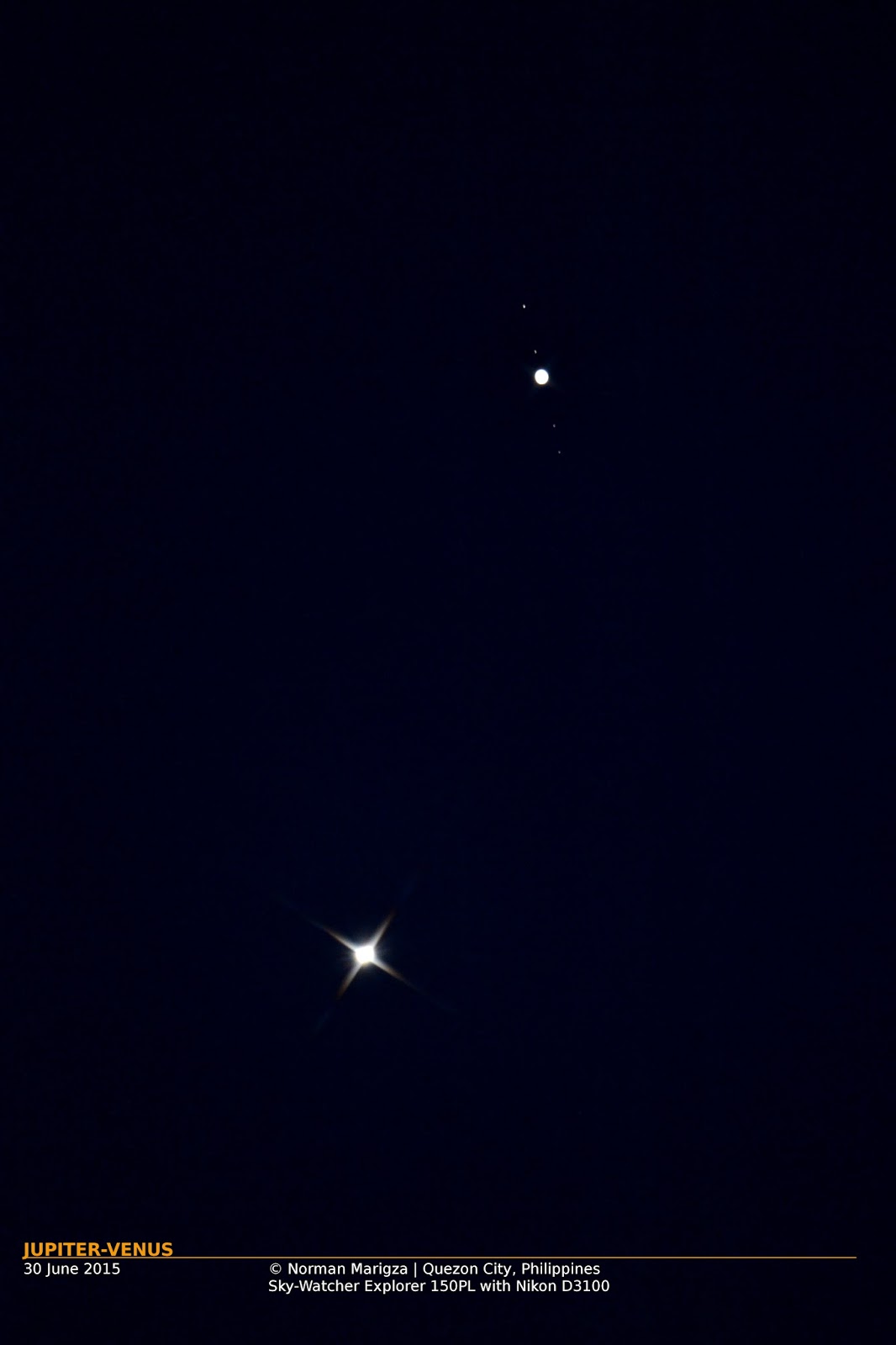
Venus-Jupiter Conjunction

Tonight will be the closest planetary pairing between Jupiter and Venus (0.3 degrees apart) after a very long period. This conjunction of the two planets is believed as one of the likeliest candidates for the 'Star of Bethlehem'.

A lot of amateur and professional astronomers throughout the world have been observing these two as they get closer and closer each night. I have planned to document their displacement in the night sky however cloudy skies have been dominant as of late.

Here are my images taken as of last night (June 30).


Note:
Unfortunately, my close-up image was plagiarized last night. The copyright was cropped out and the levels edited, but you could still tell it was my image from the distinct features (besides I have the RAW). You may share my images but please retain the image credits and do not claim it as your own.

Tuesday, May 5, 2015

SolarActivity Picture of the Day


As I opened my Facebook this morning I was surprised at the first item in my news feed. My eyepiece projection shot for May 5, 2015 was selected as the SOLARACTIVITY PICTURE OF THE DAY. I'm not a pro at astrophotography like most of the members usually featured so I was quite pleased to find my image as the POD.


My photo was taken via an improvised eyepiece projection setup attached to my Sky-Watcher Explorer 150PL on a wooden dobsonian mount (or "alpha" as we call it). The seeing was great that morning so I was able to get good detail. I also recently have been experimenting on a new style of false color processing which gets rid of the burnt out look in the limb. [see original image here]

If you want to check out great solar images (white light, H-alpha, CaK, etc.) from different observers around the world check out the SOLARACTIVITY group.

Wednesday, March 18, 2015

Star Trails


Last night I did my first attempt at making star trails. These is one of the shots that must be tried at least once by anyone doing astrophotography/nightskapes. This shot is made by allowing the rotation of the Earth to cause shifts in the apparent position of the stars (rise -> set).

I hit a few bumps, but still the end result was satisfying for a first attempt. Limited by my current gear, each of my subs are taken at the standard 30 second exposure time (I have no shutter-release cable or a shutter remote to maximize the bulb setting). My Nikon D3100 also takes an automatic dark frame subtraction after each exposure, so there is a delay in between the exposures (seen as gaps between each light frame). I learned that you can trick the camera to skipping the dark frame subtraction by turning off the DSLR after each exposure. However, my camera has been acting up and I also wanted all unnecessary contact to be avoided with my setup (I accidentally hit my tripod twice, resulting to the two large gaps in every trail).

The end result makes use of 51 subs totaling to 25.5 mins of exposure. Each of the light frames are manually calibrated in GIMP to produce a clean image. You may use available reduction software from the net to do the calibration for you.

Sunday, March 1, 2015

Luna Not So Gray

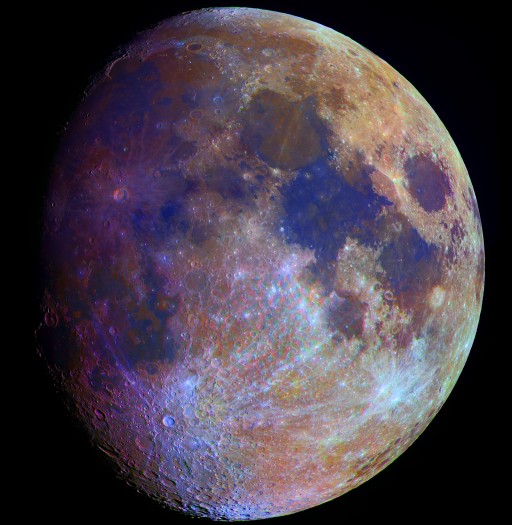
We know that through atmospheric lensing the lunar surface changes its hue from the normal gray to anywhere between yellowish to red. But did you know that the Moon isn't actually just gray.


The Moon contains subtle hints of color that is not normally seen by our eyes. Photographic methods can bring out these subtle variations of color. These various hues are a result of the chemical distribution and abundance in the lunar surface. The mare regions or the 'seas' (the darker areas) have lower capacity to reflect light because of higher ferrous oxide (FeO) content. The bluish hues are a result of the abundance of titanium oxide (TiO2) which further limits the surface reflectivity. TiO2 has a high distribution in Mare Tranquillitatis (Sea of Tranquility); seen in the photo as the blue region. Orange and purplish hues are a result of the lower abundance of TiO2 and FeO. The pinkish hues are from iron-poor, aluminum-rich lunar highlands.

Here are some other images of the Moon in exaggerated colors to provide contrast from the common Lunar hue:


Here is an image entitled 'The Color of the Moon' from APOD (16 February 2006) by Johannes Schedler (Panther Observatory).


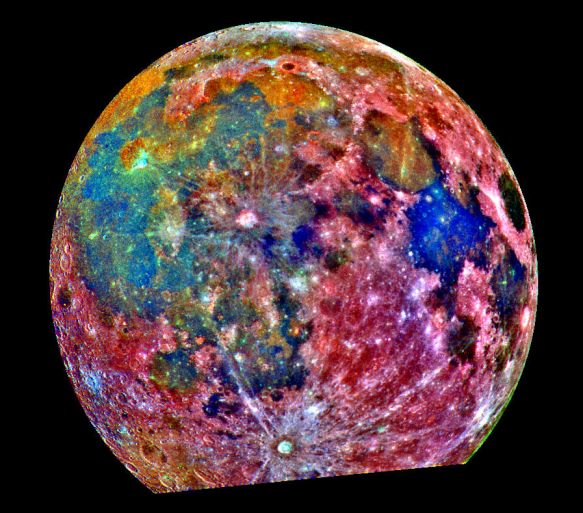
Not only do ground based observers try to see these colors but spacecraft as well. Here is another one by the Galileo spacecraft imaged in 1992.


- - - April 20, 2019 - - - For those coming to this blog post in relation to the pink Moon - - -

The Pink Moon is merely a name given by the Native Americans to the Full Moon of April due to it coinciding with the onset of the blooming of the pink phlox (a flower in North America). This name and other Moon names do not apply to the Philippines.

Here is my original post caption to this link being shared:
Alright, allow me to weigh on this from an astronomer's perspective.
Friend's in the local astronomy community have been tackling the pink tinted photos being shared on social media with good reason - they are not real and are reinforcing the wrong notion of people on the 'Pink Moon' (even with all the reference to the Pink Phlox in the Native American Moon names).

The Moon actually has pink hues resulting from iron-poor, aluminum rich lunar highlands (and these ARE NOT visually distinguishable). Highlands are the brighter older areas, while the lowlands are the darker spots on the lunar surface.

In this blog post I made in 2015 you can see the distribution of the pink hues on the lunar surface. Now from these you can tell the difference from all these recent pink-hued Moon pics as they are mostly all pink as a result of camera optics and not of the actual color of the Moon. The lack of other hues from chemical distribution in the lunar surface shows that these photos are not representative of the actual Moon.
I've been imaging the Moon since I was in college until I was teaching astronomy in college and have encountered this pink hued Moon images from certain camera models (depending on the setting). Please do not confuse the image color with the actual color of the Moon.

- - - - - - -

 The image set seen here were taken on May 2010 just minutes from each other with a Canon PowerShot S3IS. Slight changes to the camera produced a pink tint in the image color without any post-processing. Although some images appeared pink they do not signify that the Moon itself appeared pink.

Notice how the low-lands are also pinkish in hue when they shouldn't be.

Friday, February 27, 2015

Solar Image: 28 January 2015


Solar image for January 28. Still low sunspot activity in the Sun. AR 2290 is now receding from the Earth facing side.  The previous grouping with no NOAA designation is now labeled as active region (1)2294.

Below are the 3D rendering of AR 2294 from yesterday and today. There is a huge difference in the structure of the sunspot group.


Thursday, February 26, 2015

Solar and Lunar Image

Here is the solar image from today, and the lunar image from last night.

The Sun currently has a low sunspot activity, so observations would be ideal in other wavelengths at the moment rather than in white light. There is a grouping at the center (below solar equator) that currently has no NOAA designation.


Tuesday, January 6, 2015

Comet C/2014 Q2 (Lovejoy)

I've only gotten back in Manila from the holidays and decided to take a shot at comet Lovejoy. I wasn't able to do it earlier since I left my usual gear (camera and travelscope) while away since we didn't have much space in the car. Comet C/2014 Q2 was first spotted by Terry Lovejoy last August.

Anyways, I decided to take out my dobsonian and scanned for the comet which is now in Eridanus. The moon and Manila's light and air pollution made it a bit challenging to observe the stars of Eridanus.

I was able to spot the comet by using omicron eridani (Keid & Beid) as my reference point. These stars were relatively bright and close enough to the comet's current position. I took multiple frames of the comet each at 1.3 seconds only given that my setup had no tracking capacity. Unfortunately I couldn't stack them together either since my laptop had limited memory to run conventional stacking softwares.


I ended up my night by taking a shot at Jupiter and the moon.


To aid you in searching for Comet Lovejoy, you can check out it's current position at TheSkyLive. Happy hunting! :)

Wednesday, October 8, 2014

Blood Moon 2014

We were initially set-up at Trinoma to have a good view of the moonrise. However, the cloudy skies made us want to call it a night. As we were leaving the Moon began to appear. One jeep ride and a short run after we were able to setup the telescope (thank God its a Dobsonian) and image away. Bible study goers at the UCCP-CHR as well as jeepney drivers joined in as we observed. Here are some of the images I took:


Tuesday, April 1, 2014

Lunar Observation - 1 April 2014

It has been a while since I have been able to image a thin Waxing Crescent Moon. There was this condominium unit being built beside my old place in Cubao, Quezon City which completely obstructed my Eastern view. Now I have a wider and darker sky here at Proj. 6.

Here are 2 pictures of a roughly 2 day old moon with 3.7% illumination. The first one is taken with a 6" Newtonian reflector, while the second was through a short-tubed 70 mm refractor.

Wednesday, June 5, 2013

5 June 2013 - Solar Observation

This morning I setup the 8" Sky-Watcher SkyLiner with our intern from the University of Michigan and some BS Astro-Tech students for a solar observing session. Two sunspot groups were very prominent AR 1762 and AR 1764. Other sunspot groups were noticed later through imaging.


From our observations, the computed sunspot number R is 82.83 with 3 sunspot groups in the Northern Hemisphere (a 3rd with no AR designation as of 11 AM), and 3 sunspot groups in the Southern Hemisphere.


Friday, May 31, 2013

30 - 31 May Lunar Observations

I woke up much later than usual on the morning of May 30. The sky was already of a blue hue and hardly any stars were visible. I was only able to squeeze in a few shots before having to prepare for work.


 The sky was clear on the morning of May 31. I had to setup outside since the Moon was low enough for it to be obstructed by the neighboring houses. I was able to capture a several good close ups of the lunar surface.


Tuesday, May 28, 2013

29 May 2013 Lunar Observation

The sky was partly cloudy this morning so I wasn't able to get close ups of the lunar surface. I only had a few minutes in a cloud gap.


28 May 2013 Lunar Observation

The Moon will be rising much later during the waning phases. Some people are not able to observe the waning phases since you either have to stay up late or rise up early. As an observer, I personally have not been able to complete one straight lunar cycle due to this factor and of course, cloudy weather. This were taken during the early morning of May 28. I suddenly had a drive to image the waning phases of this month's perigee Moon for a project.