Wednesday, July 1, 2015

Venus-Jupiter Conjunction (July 1)

Here are my shots of the close planetary pairing of Venus and Jupiter.

 Under-exposed to reveal the crescent Venus and the bands on Jupiter

 Exposed to reveal three of the Galilean moons (Europa hidden in Jupiter's shadow)


My June 30 shots can be seen at the previous post or as featured in AWB.

Tuesday, June 30, 2015

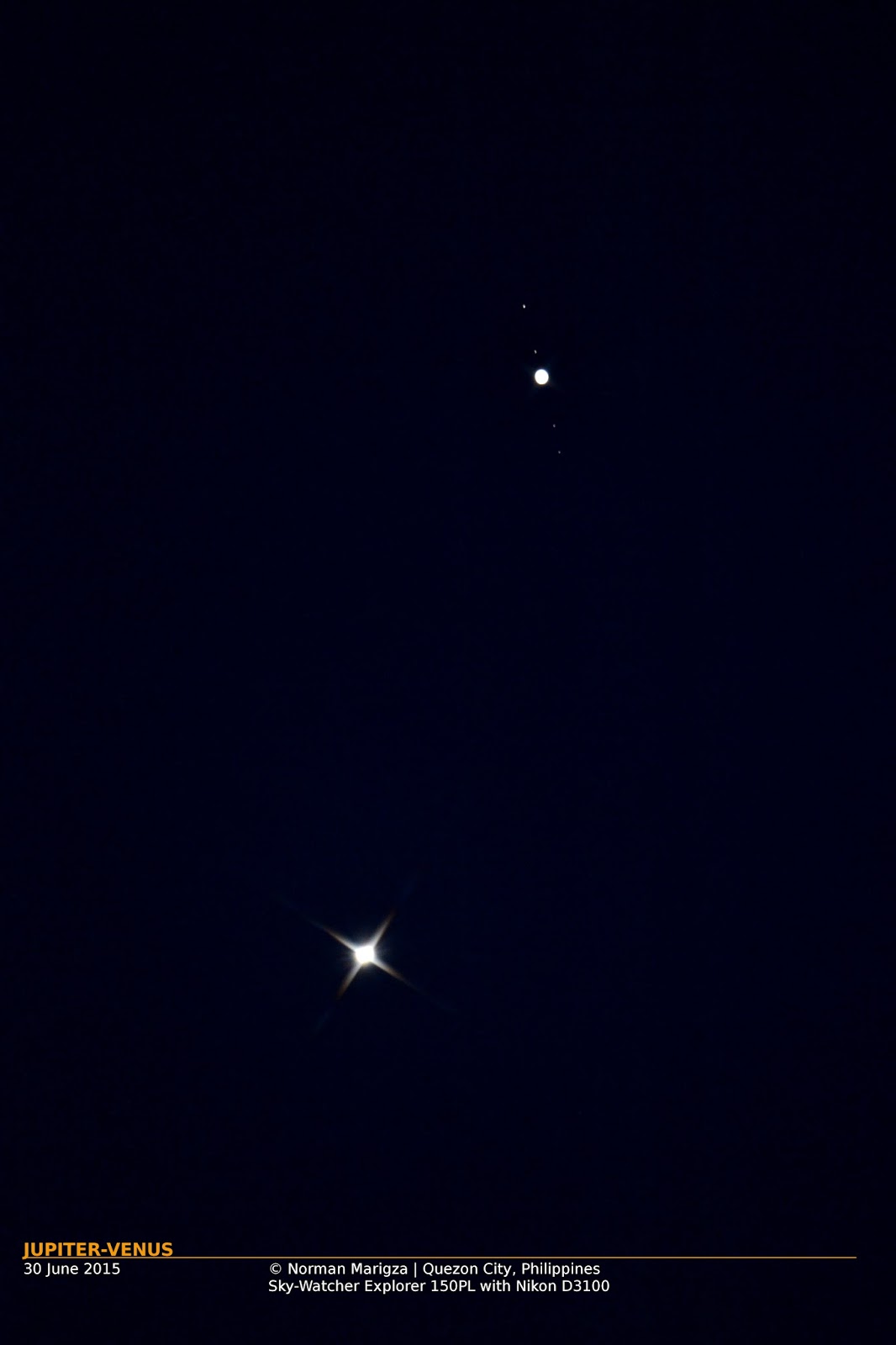
Venus-Jupiter Conjunction

Tonight will be the closest planetary pairing between Jupiter and Venus (0.3 degrees apart) after a very long period. This conjunction of the two planets is believed as one of the likeliest candidates for the 'Star of Bethlehem'.

A lot of amateur and professional astronomers throughout the world have been observing these two as they get closer and closer each night. I have planned to document their displacement in the night sky however cloudy skies have been dominant as of late.

Here are my images taken as of last night (June 30).


Note:
Unfortunately, my close-up image was plagiarized last night. The copyright was cropped out and the levels edited, but you could still tell it was my image from the distinct features (besides I have the RAW). You may share my images but please retain the image credits and do not claim it as your own.

Monday, June 15, 2015

Save the Night for Sea Turtles

Today (June 16) is World Sea Turtle Day – a day used to honor and highlight the importance of sea turtles. These wonderful creatures are at risk due to various human activity, including the presence of artificial lights.

Now for those in the astronomy scene we value the dark night sky in order for us to appreciate the wonders of the universe. But known to little is the threat of light pollution on these endangered creatures. Female sea turtles look for dark coastal areas to nest their eggs and to keep them protected. The presence of coastal lights prevent them from finding suitable nests for their eggs. Sometimes coastal lighting casts shadows on some areas that to the turtles may seem dark and suitable, but is actually exposed come daylight.

Sea turtle hatchlings also have a natural programming that direct them towards the safety of the sea. For centuries the reflection of the moon and stars on the sea have guided them. With the presence of artificial coastal lighting today, they are disoriented and crawl away from the water and into roads or populated regions where they end up ran over or sold as pets (which is illegal for endangered species). Others who don't find their way become exhausted and dehydrated until they perish.
 
Gamay, a Hawksbill turtle rehabilitated in the Silliman University Marine Lab and released in the Apo Island Marine Sanctuary.
Among the critically endangered sea turtle species are the hawksbill sea turtle (Eretmochelys imbricat) who have been reported to lay eggs in the populated and highly commercialized island of Boracay. We have four other species of sea turtles inhabiting the Philippine waters - Loggerhead (Caretta caretta; endangered), green sea turtle (Chelonia mydas; endangered), leatherback sea turtle (Dermochelys coriacea; critically endangered), and the Olive ridley sea turtle (Lepidochelys olivacea; vulnerable).

Sea turtles are only part of a large number of species of animals affected by artificial light at night. So let's help protect these species by avoiding the use of excessive and unshielded lighting. In doing so, you also allow astronomers, stargazers, and astronomy enthusiasts a better view of the sky. All these animals are affected - and you and I are among them.


If you are interested to help monitor the levels of light pollution in the Philippines, you can join us at the Philippine Light Map project.

Friday, May 22, 2015

Philippine Light Map

2015 is the International Year of Light and Light Based Technologies (IYL2015). As participation to the event, a few students and I (from the Guild for Astronomy Innovation and Advancement) started the Philippine Light Map Project. It was a program I initially proposed to RTU last year, but none of the faculty then took it up. It was formally announced to the public during the last monthly meeting of the Astronomical League of the Philippines (ALP) with members of the UP-Astrosoc present.

The Philippine Light Map Project is designed to monitor the light pollution levels in the country. It aims to involve members of the astronomical and scientific community, as well as the local community, to provide scientific data by submitting images of the night sky which will then be subjected to photometric analysis. A map of the Philippines will then be generated with indications of light levels over areas that have been able to provide data.


Objectives:

  • To gather collective image data from members of the astronomical community all over the country and create a photometric light map to monitor the status and changes in the levels of light pollution in the Philippines.
  • To determine areas with dark skies for possible observation sites.
  • To determine value of wasted energy resource at night and determine the trend of growing/decreasing energy consumption.
  • To advocate dark-sky preservation and conservation of energy resources.

Various groups in different regions will be asked to be involved so that they may conduct and gather data from their own local regions. The project is designed to run continuously so that the changes may be monitored in the light levels and that the rate of wasted energy may be determined. The data can be presented to local government units (LGUs), the Department of Environment and Natural Resources (DENR) as well as the National Energy Commission (NEC). The data presented can be used to propose lighting ordinances to limit the amount of light pollution. The project can also be coordinated with various international efforts that support the preservation of the night sky such as: the International Conference in Defense of the Quality of Night Sky, International Dark-Sky Association (IDA), International Astronomical Union (IAU), and the United Nations Education, Scientific and Cultural Organization (UNESCO) World Heritage Committee.

How to get involved?
1. You may submit your images of the night sky for photometric analysis at the facebook group page of the Philippine Light Map. Ideally, a standard star must be included in the image field (please do not over expose the star; you may search the web for a catalog of photometric standard stars). Try your best to achieve a point focus for stars (if you zoom in on an unfocused star it tends to create a donut like shape). Also, ideally we want a narrow field view of view so set your lenses at the highest magnification; or your telescope attachments at prime focus.

Please indicate the date & time, observation site, camera model, lens and telescope used, as well as the location of the field you will submit (perhaps in RA/DEC).

2. If you have no camera you may use the star counting method designed by the International Meteor Organization to give an estimate of the limiting magnitude of your sky.

3. Reach out to your photographer contacts across the country to help get images; or advocate the importance of preserving a dark night sky.


Manila Street Astronomers at Star City

Last weekend, Gary Andreassen invited Christopher Lu and I to join him in Star City for a stargazing event. The amusement park was closed to an exclusive event for the HSBC GSC employees and their families.

Gary and I were first at the scene, and set up close to the roller coaster towards the employee exit. As we were setting up the 8-inch reflector a crowd gathered around us, excited to see what we have to show. Naturally, the amusement park is light polluted so we chose the planet Jupiter as our target.

Star City's PA system also announced our little setup and eventually the line to look at the telescope became as long as the roller coaster line. Christopher Lu eventually arrived and I was able to switch to Saturn which was now high enough to get away from the glare of a light from the ferris wheel side.


Despite the light pollution, we were able to successfully  share the wonders of the universe to people who looked through the telescope (mostly for their first time).

Every once-in-a-while you may catch Gary at SM South Mall, and Christopher at Kalentong setting up their telescopes for a free public viewing.

Solaractivity Picture of the Day (May 20)

My sunspot painting was selected as the Solar Activity Picture of the Day for the 20th of May.


I've been recently cooped up indoors (against my will) while renovations are being done at home. With all the clutter and construction taking place I couldn't manage to drag 'alpha' out for solar imaging/data gathering. So for two afternoons I worked on this painting of a sunspot group.

Tuesday, May 5, 2015

SolarActivity Picture of the Day


As I opened my Facebook this morning I was surprised at the first item in my news feed. My eyepiece projection shot for May 5, 2015 was selected as the SOLARACTIVITY PICTURE OF THE DAY. I'm not a pro at astrophotography like most of the members usually featured so I was quite pleased to find my image as the POD.


My photo was taken via an improvised eyepiece projection setup attached to my Sky-Watcher Explorer 150PL on a wooden dobsonian mount (or "alpha" as we call it). The seeing was great that morning so I was able to get good detail. I also recently have been experimenting on a new style of false color processing which gets rid of the burnt out look in the limb. [see original image here]

If you want to check out great solar images (white light, H-alpha, CaK, etc.) from different observers around the world check out the SOLARACTIVITY group.