Monday, June 23, 2014

International Sun-Day Report

Participants pose beside the telescopes

The Solar Observation Program (SOP) in cooperation with the RTU Astronomical Society had a setup in the quadrangle of Rizal Technological University. We setup two telescopes for the public observation: a Sky-Watcher SkyLiner 200P with a black polymer filter and a Lunt LS60THa Solar Telescope. For most of the participants it was their first time to look through an H-alpha telescope to view the Sun. Several freshmen students were present as well who have never experienced solar observations. Solar glasses from the Charlie Bates Solar Astronomy Project were also distributed by SOP member Margareth Custodio. The sky was generally clear although a few clouds rolled in every once in a while.

Students viewing the Sun through the CBSAP solar glasses
Students taking turns peeking at the Sun

Teaching how an H-alpha telescope works

 After the public observation we proceeded to the astro-auditorium to watch Star, an episode from BBC's Planets. The film Star discussed concepts about our own star and how our understanding of it has developed through the years. It was followed by a Q&A where students opened up their questions regarding the Sun.

Astronomy students pose for a group shot after the film showing.

Afterwards the group proceeded with lunch and some members came along to join forces with another participating partner in Rajah Sulayman park - the Astronomical League of the Philippines.

The setup of ALP at Rajah Sulayman park


-Norman Marigza
Head, Solar Observation Program

Wednesday, June 18, 2014

International Sun-Day

This Sunday, June 22, 2014, the world will celebrate the International Sun-Day. The event is organized by Pamela Shivak (founder) and Stephen Ramsden (Director, CBSAP).

Two groups from the Philippines are official participating partners: the Astronomical League of the Philippines, and Rizal Technological University's Solar Observation Program and Astronomical Society.

The SOP will be setting up their solar observation in the RTU quadrangle at 10:00 AM and will be conducting an infographic campaign on facebook.

ALP will be setting up a free public viewing of our very own star at the Rajah Sulayman Park at 3:00 PM. Feel free to join us if you are in the area.


To learn more and see a listing of all the participating partners throughout the globe, you can visit: solarastronomy.org

Saturday, May 10, 2014

Solar Morphology

Here is another animated gif image of the Sun for the period of April 20 to May 9. 

I've been wanting to do this for quite some time but always get interrupted by days with no data (either due to bad weather or absence from my equipment during trips). This gif sequence allows us to view the daily changes in the structure of each active region as they go about their solar transit. This animation was done on a daily basis and images were mostly taken in the morning before I leave for work. My next goal is to do this with shorter time intervals between shots (perhaps one in the morning and in the afternoon) to better monitor the slight changes in the sunspot group structure. I have already planned the project with two astronomy students from RTU - Mico Enriquez and Margareth Custodio.

Monday, April 21, 2014

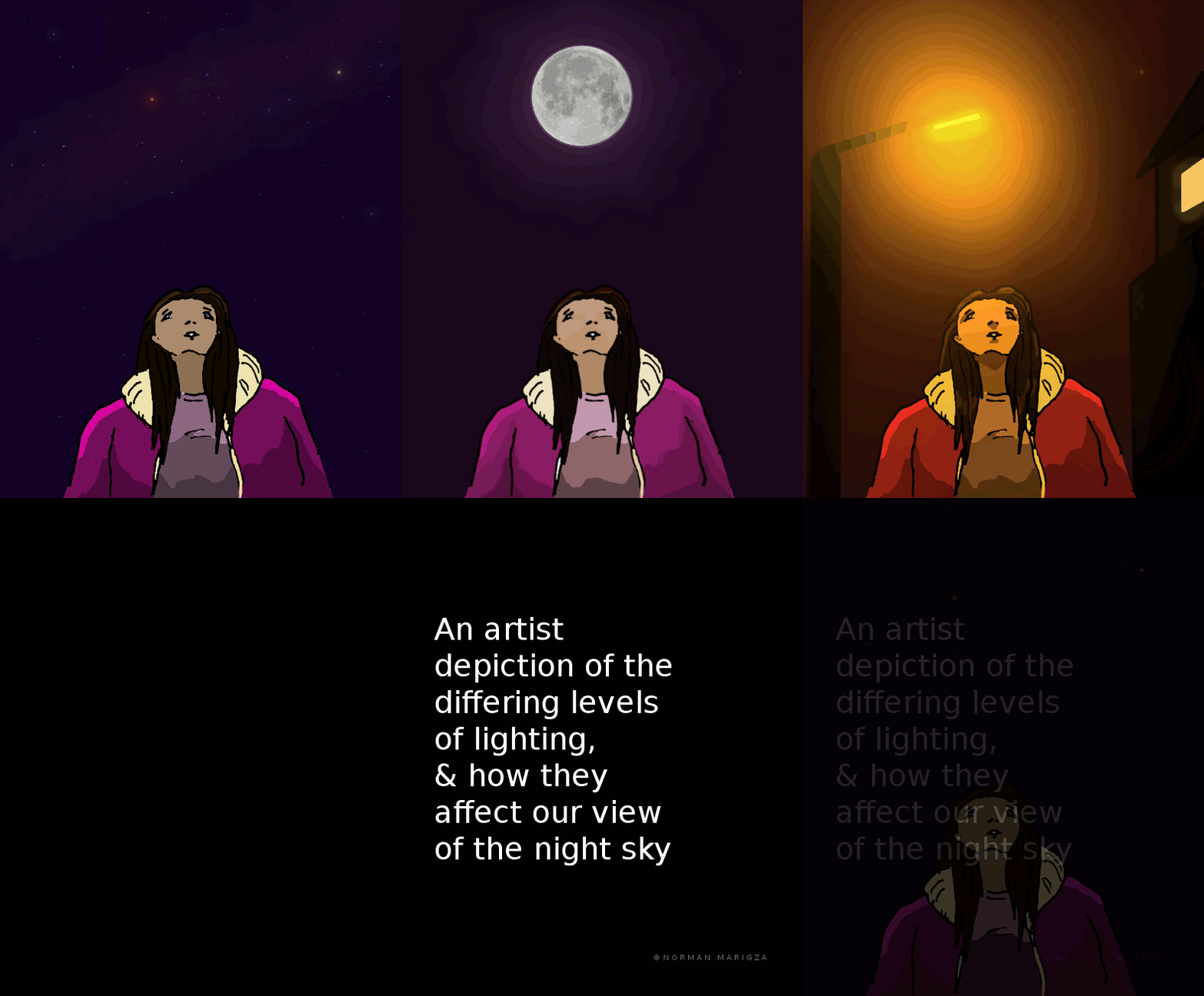
A Comic Guide to Observing Meteors

Here's a little something to serve as a practical guide to observing meteors. I hope you enjoy it.


1. During a meteor shower be sure to observe in a dark site. The darker the site the better the visibility for meteors. Observing near city lights or during a bright phase of the moon will limit your visibility. However, make sure that the dark site is secure.



2. Know where to look. Meteor showers are named after their apparent source or radiant. Look for meteors away from the proximity of the radiant. Using star charts may be helpful.


3. Grab a mat or reclining chair so you can observe the meteors with ease. You may end up with a stiff neck if you don't.


4. Use insect repellents. You want to be counting meteors and not counting bites or swatting at elusive mosquitoes.


5. Check the weather forecast prior to a scheduled observation. The last thing you want is to waste your time waiting for clouds to clear up.


*PS. If you have other things you want me to add, feel free to comment :)

Sunday, April 13, 2014

Morphological View of the Sun

Here is a little animation showing the daily changes in the solar surface. I plan to track the transit of AR 2032 across the solar surface. Hopefully I won't have any cloudy days to cause gaps in the data. The following is taken from April 9 - 13, 2014.


Monday, April 7, 2014

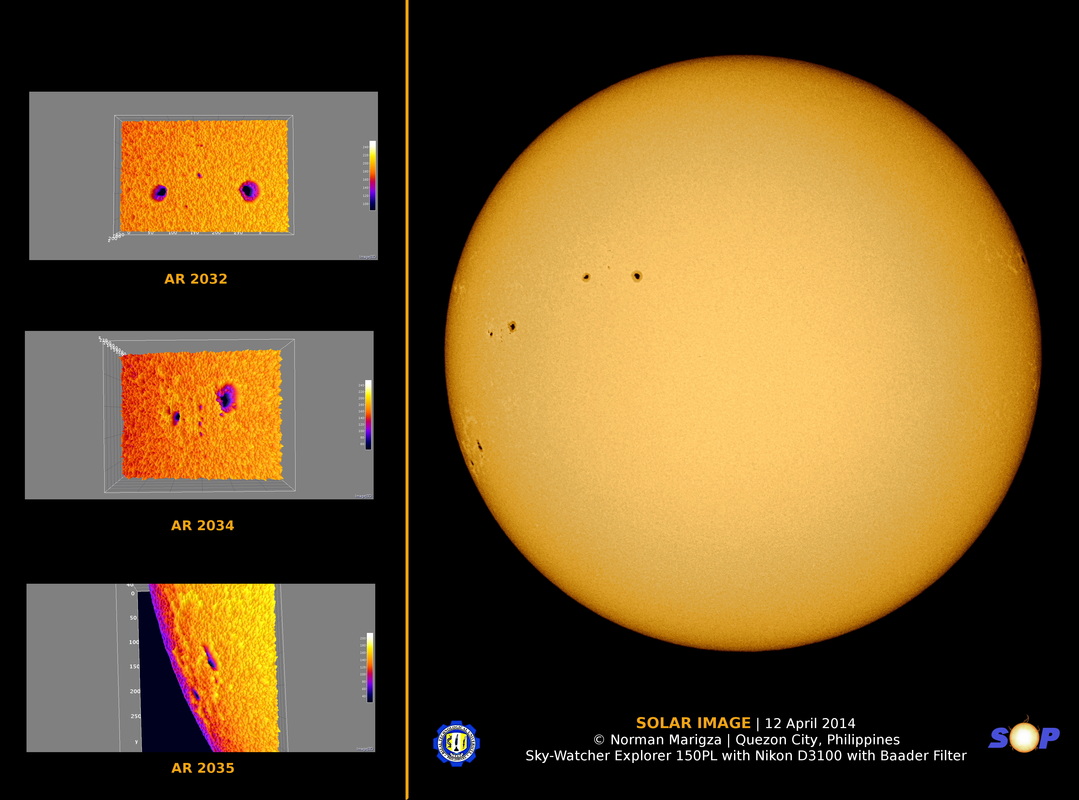
3D Sunspot Rendering using ImageJ

Resolution is one problem in scientific image data acquisition. In observation of sunspot groups, we need to have enough resolvable detail to make out the proper features for sunspot counting and McIntosh classification. A lack of resolution may lead to lower estimates to the level of solar activity. As a result, some image processing measures are taken to improve resolution, however this tampers with the data.

A useful technique is to render an isophote of the image in order to make out details. Isophotes use pixel intensity to map out areas with different concentrations. This is usually used in mapping out topological terrain.

The software ImageJ allows users to construct 3D isophote rendering of sunspot groups. This helps make out points which are hard to see visually. Intensities can also be adjusted to make out fainter points.


Tuesday, April 1, 2014

Lunar Observation - 1 April 2014

It has been a while since I have been able to image a thin Waxing Crescent Moon. There was this condominium unit being built beside my old place in Cubao, Quezon City which completely obstructed my Eastern view. Now I have a wider and darker sky here at Proj. 6.

Here are 2 pictures of a roughly 2 day old moon with 3.7% illumination. The first one is taken with a 6" Newtonian reflector, while the second was through a short-tubed 70 mm refractor.