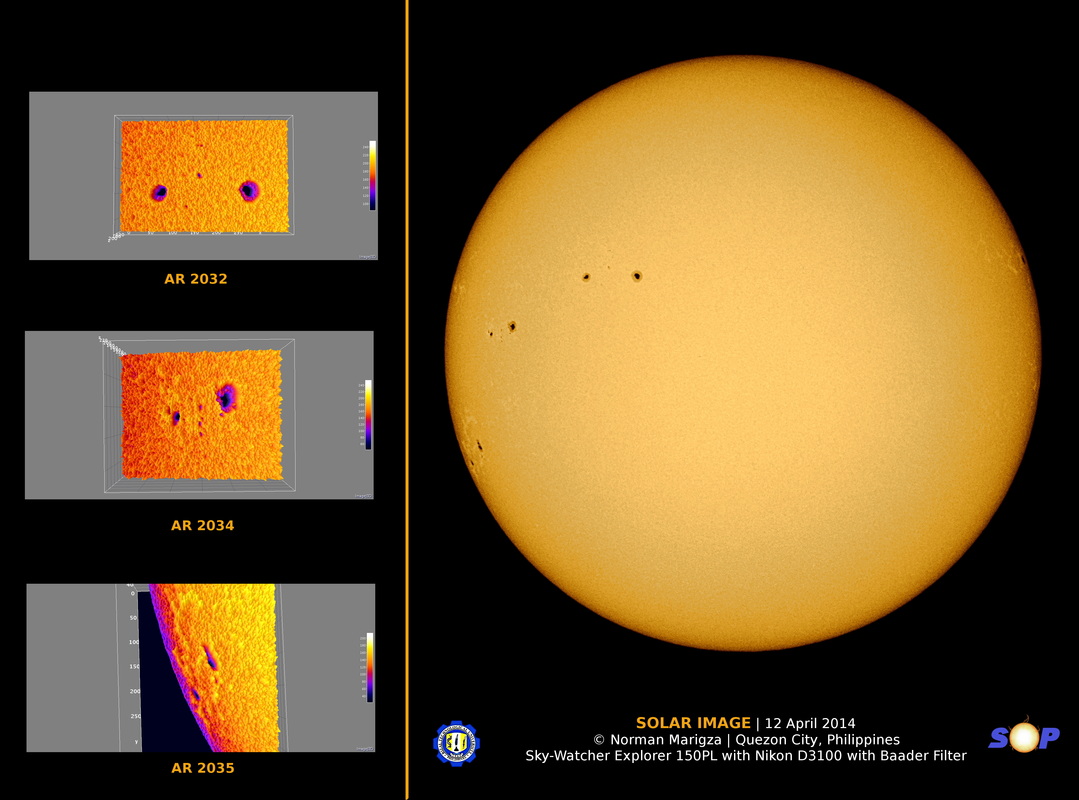
Here is a little animation showing the daily changes in the solar surface. I plan to track the transit of AR 2032 across the solar surface. Hopefully I won't have any cloudy days to cause gaps in the data. The following is taken from April 9 - 13, 2014.
Sunday, April 13, 2014
Monday, April 7, 2014
3D Sunspot Rendering using ImageJ
Resolution is one problem in scientific image data acquisition. In observation of sunspot groups, we need to have enough resolvable detail to make out the proper features for sunspot counting and McIntosh classification. A lack of resolution may lead to lower estimates to the level of solar activity. As a result, some image processing measures are taken to improve resolution, however this tampers with the data.
A useful technique is to render an isophote of the image in order to make out details. Isophotes use pixel intensity to map out areas with different concentrations. This is usually used in mapping out topological terrain.
The software ImageJ allows users to construct 3D isophote rendering of sunspot groups. This helps make out points which are hard to see visually. Intensities can also be adjusted to make out fainter points.
Tuesday, April 1, 2014
Lunar Observation - 1 April 2014
It has been a while since I have been able to image a thin Waxing Crescent Moon. There was this condominium unit being built beside my old place in Cubao, Quezon City which completely obstructed my Eastern view. Now I have a wider and darker sky here at Proj. 6.
Here are 2 pictures of a roughly 2 day old moon with 3.7% illumination. The first one is taken with a 6" Newtonian reflector, while the second was through a short-tubed 70 mm refractor.
Friday, February 21, 2014
National Astronomy Convention
In line with the National Astronomy Week, the Rizal Technological University held a National Astronomy Convention with the theme "Enticing Filipinos Through Visions of Astronomical Progress"
| RTU President, Dr. Jesus Rodrigo F. Torres |
| Keynote address by Dr. Catherine Castaneda, Director IV - CHED NCR |
| Plenary Speaker 1: Solar Observation by Dr. Jett Aguilar, Vice President of the Astronomical League of the Philippines |
| Plenary Speaker 2: Stellar and Planetary Atmosphere by Michael Bala, Weather Specialist 1 RDTD PAGASA |
| Plenary Speaker 3: Planetary Geology by Erika Valdueza, Msc Geomatics Engineering |
| Plenary Speaker 4: Solar Observation workshop by Norman Marigza, Head of the RTU-Solar Observation Program |
| Plenary Speaker 5: Gravitational Microlensing by Dr. Reinabelle Reyes, PhD, KICP Fellow in Princeton University |
| Plenary Speaker 6: Binary Stars by Dr. Thijs Kouwenhoven, PhD, Research Professor at Kavli Institute of Astronomy and Astrophysics at Peking University |
| Plenary Speaker 7: Image Acquisition and Processing by Mr. Christopher Go, discoverer of Red Spot Jr |
| Plenary Speaker 8: Space Weather by Professor Emanuel Sungging, Researcher at Lapan, Pusan Sains Antariksa, Indonesia |
| Plenary Speaker 9: Active Galactic Nuclei by Dr. Dading Nugroho PhD, Lecturer and Trainer for the Indonesia Astronomy Olympiad National Team |
Monday, January 27, 2014
Basic Photometry
Since a lot of my students are getting
into 'research mode' and require a knowledge of the means to analyze
data, I thought it would be good to make a post on some basic info
here. Among the easiest and most accessible is doing photometric
analysis. [Forgive me if I once again go about some technical info in
this blog, I will try to make it as basic as possible]
Photometry or the 'measurement of
light' allows you to do a variety of things, such as identify
magnitudes, sky brightness, limiting magnitudes, render light curves,
etc. A variety of research subjects can be tackled by photometry.
Your digital camera can act as a
detector which can be used to gather photometric data for analysis.
You also need a list of standard stars (stars with fixed magnitudes)
if you wish to make a comparison of magnitudes. Here is a sample list of standard stars (A. U. Landolt, 1992). And lastly you need a program that can do photometric analysis like IRIS or IRAF [I personally recommend Iris since it's more user friendly].
We can compare magnitudes by using the equation
m1 - m2 = -2.5 log (b1 / b2)
where m1 and m2 are the magnitudes of two stars and b1 and b2 are their corresponding brightness.
First you have to acquire an image with a standard star in your field of view. I then can set point 1 as my standard star and set point 2 for any object I wish to compare. Using IRIS or IRAF, I can measure the pixel count/intensity for both points and use them as b1 and b2 in the equation. By doing so I can identify the magnitude of any other point in the image in contrast to the standard star.
----Side note----
This type of measurements become more accurate when standard data reduction is done (lights, darks, flats, bias) and also when the appropriate filters are used (standard Johnson filters). However, I'll leave those out for another post or for you to find out on your own.
Thursday, January 9, 2014
Solar Observation: 9 January 2014
Here are some images taken for the Solar Observation Program (SOP) in RTU. With me were Raven Pelobello and Babie Rose Quiniquis, two of the freshmen members of the SOP.
Of particular highlight right now is the huge sunspot group AR 1944 (above image) which over the past few days has released several flares including an X-class flare. The size and structure of the sunspot group puts it at an Fkc classification which corresponds to a high solar flare probability. NOAA forecasters estimate an 80% chance of M-class flares and a 50% chance of X-ray flares over a period of 24 hours.
Sunday, December 1, 2013
Andromeda Mobile Planetarium
A new planetarium service has opened in the Philippines, and it opened up in my home town - Baguio City.
Welcome the Andromeda Mobile Planetarium, a private business in partnership with Rizal Technological University's Department of Earth and Space Sciences that caters to students all over the Cordillera region. The planetarium features a 6 meter dome, and various exhibits such as a meteorite collection and images taken from John Nassr's Stardust Observatory in Baguio City.
The Andromeda Planetarium is temporarily set-up at the Porta Vaga mall to allow the public to come and visit. The dome will be circulating in the different schools in the region to promote awareness and interest in the science of astronomy.
Subscribe to:
Posts (Atom)