Showing posts with label Dark skies. Show all posts

Sunday, April 7, 2013

International Dark Sky Week


April 5-11 is the International Dark Sky Week. It is part of the Global Astronomy Month celebration, and a program of the International Dark-Sky Association, that seeks to share the beauty of the night sky and at the same time raise awareness on the issue of light pollution.

Light pollution is not just a problem for astronomers, but it is also a problem that affects the environment, the energy sector, as well as our health.

Part of the efforts to make others aware of dark-sky preservation is the measurement of light pollution levels as well as sharing wonderful images of the night sky in a vantage point of a dark site. I decided to upload some of my astrophotos of various starfields in the Philippines to aid in dark-sky awareness.

Dark-skies from Tuding, Baguio City
Late night sky from RTU, Mandaluyong. Sky is still sufficiently bright due to urban lighting.
Ursa Major region taken from Taytay, Rizal

Dark skies from Laguna
PAGASA observatory, Quezon City
Night sky from Dumaguete City, Negros Oriental

Tuesday, January 24, 2012

Observation at Taytay, Rizal

Last Saturday, the astronomy graduate school students of RTU went out to Taytay, Rizal for an overnight observation. We set up in a place called Paradiso and set out to observe several targets as well as spend some time together. We brought along 4 telescopes (2 Astromaster 130s, 1 Meade ETX 125 and my TS 70) with us as well as several binoculars to observe the night sky. I brought my imaging gear with me but had to deal with winds shaking up my tripod.


We were able to observe several clusters, the planets Jupiter, Venus, Mars and Saturn, as well as some DSOs. We also were able to see several sporadic meteors most of which were bollides.


Participants: Von, Peejay, Joey, Ruby, Ryan, Pia, Pamela, Lieza, Vanessa, and myself.

Sunday, November 6, 2011

AstroEscapades

During the long weekend I went up to my home town - Baguio City. I checked the weather for Baguio City using weatherspark which was introduced by Dr. Lee in the October meeting of the ALP. The weather was good for that week and my classmate in astronomy, Vanessa, was able to do some observations when she was in Baguio before me. Also, John Nassr from Baguio had wonderful images recently posted to his website.

Since the weather seemed to participate, I brought along my Celestron Travel Scope 70. I seriously put the word "Travel" in the TS 70 to the test for a stargazing tour with my relatives. The telescope is really lightweight and is easy to travel with in its custom backpack.

Aiming the TS 70 at Jupiter with my cousins.

My first stop was in Long-long, La Trinidad. It was a dark site with wonderful star studded skies (see previous post). At first we thought we weren't going to be able to see anything since it was cloudy, but knowing Baguio's skies we knew things change quickly (one minute it looks like it's gonna pour, the next it's crazy sunny). I was able to see the Milky Way after a long time and lots of faint stars that I have missed since moving to the highly urban Manila.
Imaging the stars with an Olympus E-510.

The following day, we went down to Aringay, La Union to visit our grandparents. My cousin knew a remote site by the sea where the skies were extremely dark. However, clouds began to gather as we set up the scope and camera to view Jupiter. I wanted to observe again the following night in the same site, but we had to wake up early to go to Clark. So I set up in the church however there were a lot of obstructions.


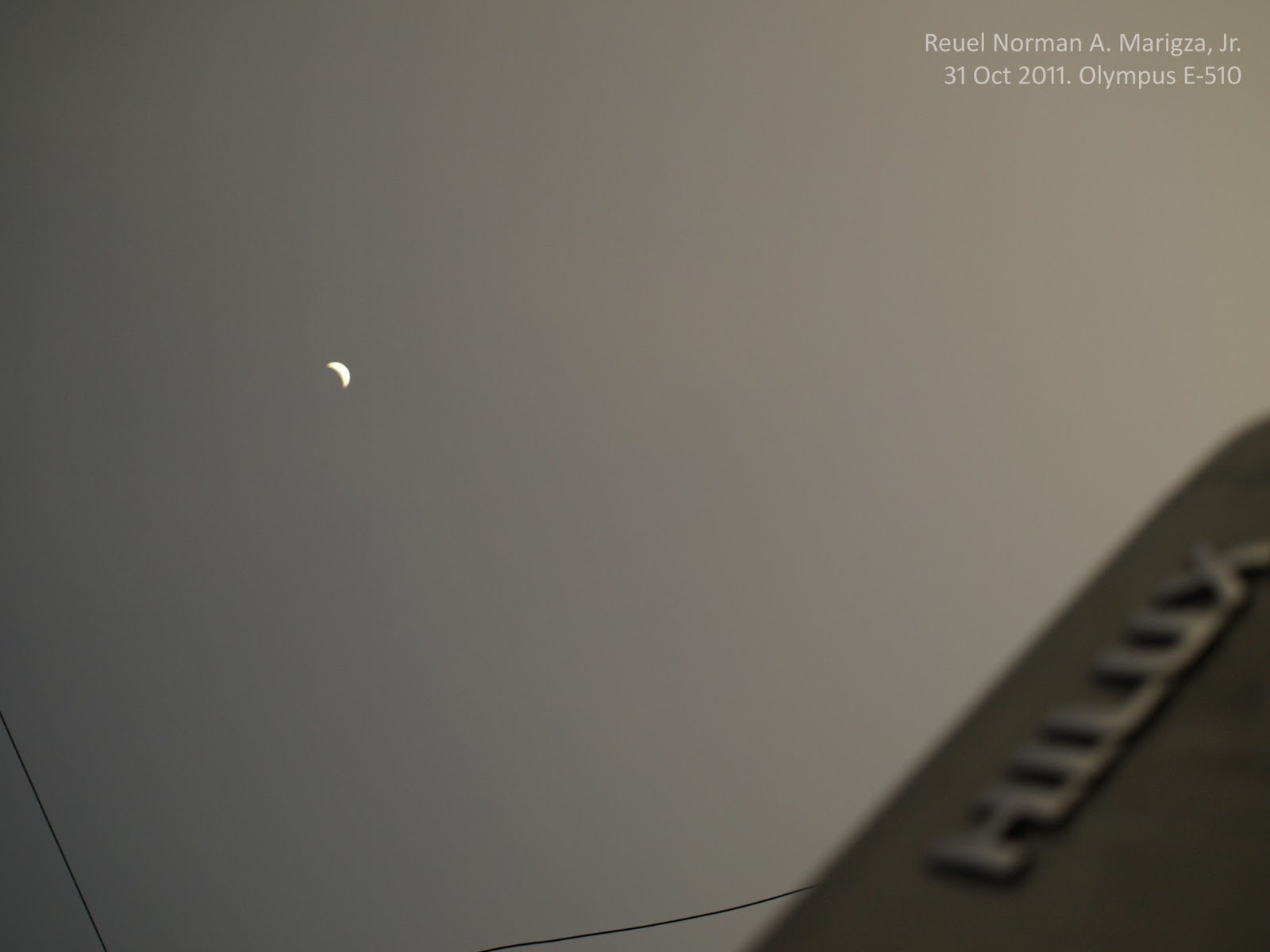
Crescent Moon imaged in Aringay.
 Unfortunately, after we came from Clark, the following nights have been cloudy and I wasn't able to do any more observations. I was able to get some images of the moon and the sunset though.

Searching for dark sky sites is a must if you really want to see more during your observations. The problem of urban sites is that light pollution washes out the fainter stars and other celestial objects making them virtually invisible. Having access to dark sky sites is a key tool in observational astronomy. Since these sites are usually in remote places it would also be effective to have a grab-&-go scope or a scope that you can easily set-up and take with you on the go.


Our ride to the observing sites.

Waxing Crescent Moon

Sunset on the road home from Clark