This is the first meteor shower I observed and I'm lucky that it was the best. The Geminids meteor shower has always been very promising. The Junior Philippine Physics society will be organizing a public observation for that event. Hopefully the weather will cooperate. We will be open on the 13th and the 14th.
The annual Geminids meteor shower will reach its peak in the night of the 14th. The meteor shower will radiate (or appear to come from) the constellation Gemini. Normally, you would be able to see around 60 per hour during good sky conditions when Gemini is low, however when it is at the zenith (point directly above you) you will get to see (+=)100 meteors per hour.
Record the beginning and end times of each of your observing periods to the minute. For those enthusiast meteor observer, you can report your observation using the methods and report forms at the International Meteor Organization site, www.imo.net.
Sunday, December 5, 2010

Thursday, November 18, 2010
Astrophotography Online
 |
| Orion Nebula |
The Harvard-Smithsonian Center for Astrophysics developed a MicroObservatory Robotic Telescope Network. This allows users online to log on to the use of the telescopes to take an image of a selected celestial body. The MicroObservatory is a network of 5 automated telescopes that can be accessed on-line.
The MicroObservatory is designed to allow students and teachers nationwide to investigate the wonders of the deep sky from their classrooms. The project is sponsored by the National Science Foundation (RED 9454767), with additional in-kind contributions from Eastman Kodak Company and Apple Computer.
Those who log on are responsible for taking their own images. This means focusing the telescope, selecting exposure times, filters, and other parameter. This helps the users get a feel of familiarity with the use of the telescopes. MicroObservatory has a wide range of targets including solar system objects, stars and nebulae, and also galaxies and deep-sky objects.
Images then can be edited by the user using a program that can be downloaded from the sight, or via other photo editing software.
Wednesday, November 10, 2010
Blackout
Last night, on my way home from the midweek service, a power line popped taking out all the lights in the area. It was relatively dark and I looked up to see the stars. I looked at Pastor Ditz recalling that I owe a stargazing session with her dormers at the Davao cottage. I told her "walang ilaw, sakto pang stargazing." She agreed excitedly telling her dormers that we will have a stargazing session at our house. At home I clamored blindly for my telescope in the dark. I rushed to set-up my scope outside with only a candle to light up my set-up. Eventually I was able to put it up and set it directly to Jupiter. I gave them a brief introduction of the telescope and Galileo's first look at Jupiter. They were naturally curious of what they saw.
The lights came back on and clouds started to cover the fainter stars, I wasn't able to show them more also because of the obstruction of trees in the area. Anyways, I promised them that I would take them to the department's astrodeck during the coming meteor shower.
The lights came back on and clouds started to cover the fainter stars, I wasn't able to show them more also because of the obstruction of trees in the area. Anyways, I promised them that I would take them to the department's astrodeck during the coming meteor shower.
Tuesday, October 19, 2010
Share the Stars
 One of the good Christian traits is sharing. In science, "the process of discovery is not complete until results can be shared with others" (Keck Observatory).
Last October 14-16, I attended a youth retreat of our church. As part of the organizers, I decided to add stargazing to our list of activities. I brought my telescope along since most of the youth have already expressed an enthusiasm for stargazing. Some have even made it a point to text me whenever a bright star appears in the night sky. I was able to show them the moon, Jupiter, the Pleiades (seven sisters). I wasn't able to show more due to obstructing clouds and a fever.
I have shared my love for astronomy to my church friends and they have shared the enthusiasm with others. I recall even in one of the stargazing sessions of the physics department that one of them came back 3 times, each time bringing someone new.
Sharing astronomy to the world is fun. You get to make people wonder what else is out there. When people wonder then they become more interested. It's a wonderful way to promote astronomy. I recall, before, during the IYA that there were even those who were 'dinumog ng street children' during one of their side walk telescoping events. The science of astronomy is loved by all, not only the academically inclined but also by common folk. You'll be amazed at the individuals who get caught up in the sharing of astronomy.
The other night, I was at Mabinay attending a Church workers assembly, I was reading a fully illustrated book entitled Smithsonian's Intimate Guide to the Cosmos. A pastor who was sitting beside me wanted to take a look. I've only began to read that book but he was already asking questions about all the pictures. We discussed Mars rovers, landscape of Venus, black holes, the giant impactor theory, solar sails, etc.
Astronomy is fascinating!
Thursday, October 7, 2010
Alpha
It's good to finally sit down and write here again :)
Well, this post is about a telescope I call Alpha. I'm surprised I wasn't able to write anything about it yet. I purchased the scope from Allen Yu using my prize money from the IYA 2009 National Olympiad.


 My scope is a Skywatcher Explorer 150PL telescope (Black Diamond). Although I don't have the equatorial mount, I still have the mount built by Allen.
I have used this scope in the physics department's stargazing, and am very pleased with the results. I'm beginning to favor this scope over the departments C8 that I usually operate.
Over the past two months, I wasn't able to use it. I was only able to use it on Tuesday, and was I lucky.. I was able to use it on Jupiter (for the first time) and also on the elusive comet 103P/Hartley.
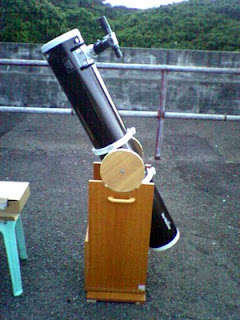
Well, this post is about a telescope I call Alpha. I'm surprised I wasn't able to write anything about it yet. I purchased the scope from Allen Yu using my prize money from the IYA 2009 National Olympiad.


I have used this scope in the physics department's stargazing, and am very pleased with the results. I'm beginning to favor this scope over the departments C8 that I usually operate.
Over the past two months, I wasn't able to use it. I was only able to use it on Tuesday, and was I lucky.. I was able to use it on Jupiter (for the first time) and also on the elusive comet 103P/Hartley.

 |
| A lunar image taken via the Explorer 150PL via afocal method |

 | ||
| First Look - astronomy enthusiast Princess Rabino gets her first look at Alpha |

Thursday, September 30, 2010
Brightest Comet of 2010 Coming Our Way
Comet 103P or most commonly known as Comet Hartley will make its nearest approach this October. It will be the brightest comet of the year 2010. Comet 103P/Hartley was discovered by Australian astronomer Malcolm Hartley in 1986. The comet has a period of 6.5 years, traveling just outside the orbit of Jupiter to nearly Earth's distance (1 AU) from the Sun. The year 2010 marks its 4th return since it was discovered, and this year is said to be its best so far.
The comet will be visible to the naked eye under a dark sky (around mag 5) as it treks a path along the constellation Cassiopea moving southeast to the constellation Gemini. Use of a binoculars will give a good view of the comet, and telescopes would be able to reveal details. Here is an image of Comet Hartley's trajectory from astronomy.com:

The comet can actually be spotted now (Sept) in Cassiopea. On October 9 it will appear in the foreground of the double cluster in Perseus. On October 20 it will be in its closest distance to the Earth and will appear in its maximum brightness, unfortunately the full moon is on Oct 23 meaning the almost full moon will make the comet less conspicuous.
In November, NASA's EPOXI [Extrasolar Planet Observation and Characterization and the Deep Impact Extended Investigation] mission will fly past the comet and return stunning images of the comet nucleus. NASA approved the retargeting of the EPOXI for a flyby on Oct. 11., after the initial target (Comet Boethin) could not be found.
astronomy.com
sky and telescope
national geographic

Observer Rolando Ligustri remotely photographed 103P/Comet Hartley 2 on September 6th (Universal Time) using a 10-inch f/3.4 Takahashi Epsilon 250 astrographic telescope.
Thursday, September 16, 2010
InOMN

Subscribe to:
Posts (Atom)